
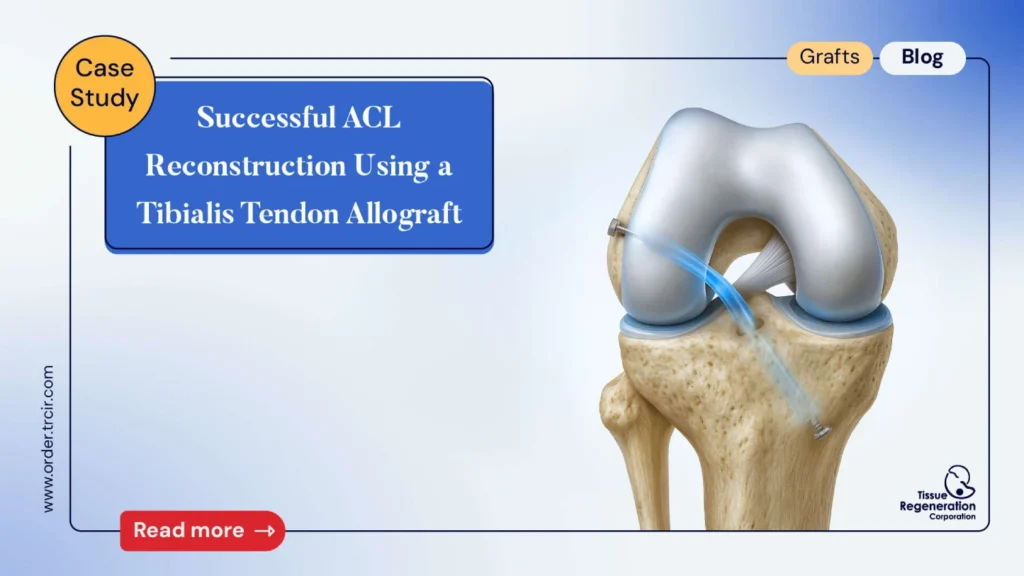
Abstract Tibialis Tendon Allograft
Anterior Cruciate Ligament (ACL) rupture is a common and debilitating injury, particularly among active individuals. While autograft reconstruction remains a popular choice, the associated donor site morbidity is a significant concern for many patients. This case study details the diagnosis, surgical management, and successful outcome of a 28-year-old recreational athlete who underwent an ACL reconstruction with an allograft, specifically using a tibialis tendon allograft. The selection of this graft aimed to provide robust biomechanical stability while eliminating harvest site complications. This case highlights the efficacy of the tibialis tendon allograft as a primary choice in appropriately selected patients.
1. Patient Presentation and Initial Diagnosis
- Patient Profile: A 28-year-old male marketing consultant, who is an avid recreational athlete.
- History of Injury: The patient presented with acute pain and instability in his right knee after a non-contact pivoting injury. He described a “pop” followed by immediate swelling and episodes of his knee “giving way.”
- Clinical Examination: Physical examination revealed a moderate joint effusion. The Lachman, Anterior Drawer, and Pivot Shift tests were all positive, confirming ACL instability.
- Imaging Findings: An MRI scan confirmed a complete, mid-substance tear of the Anterior Cruciate Ligament with associated bone bruising, consistent with the injury mechanism.
2. Pre-Operative Considerations and Graft Selection Rationale
Following the diagnosis, a comprehensive discussion was held regarding treatment options. The central part of this discussion focused on the various tendon graft choices.
- Discussion of Autograft vs. Allograft Options: Autograft options (BTB, hamstring) were discussed, but the patient expressed significant concern about donor site morbidity. The allograft option was introduced as a method to achieve knee stability without a graft harvest.
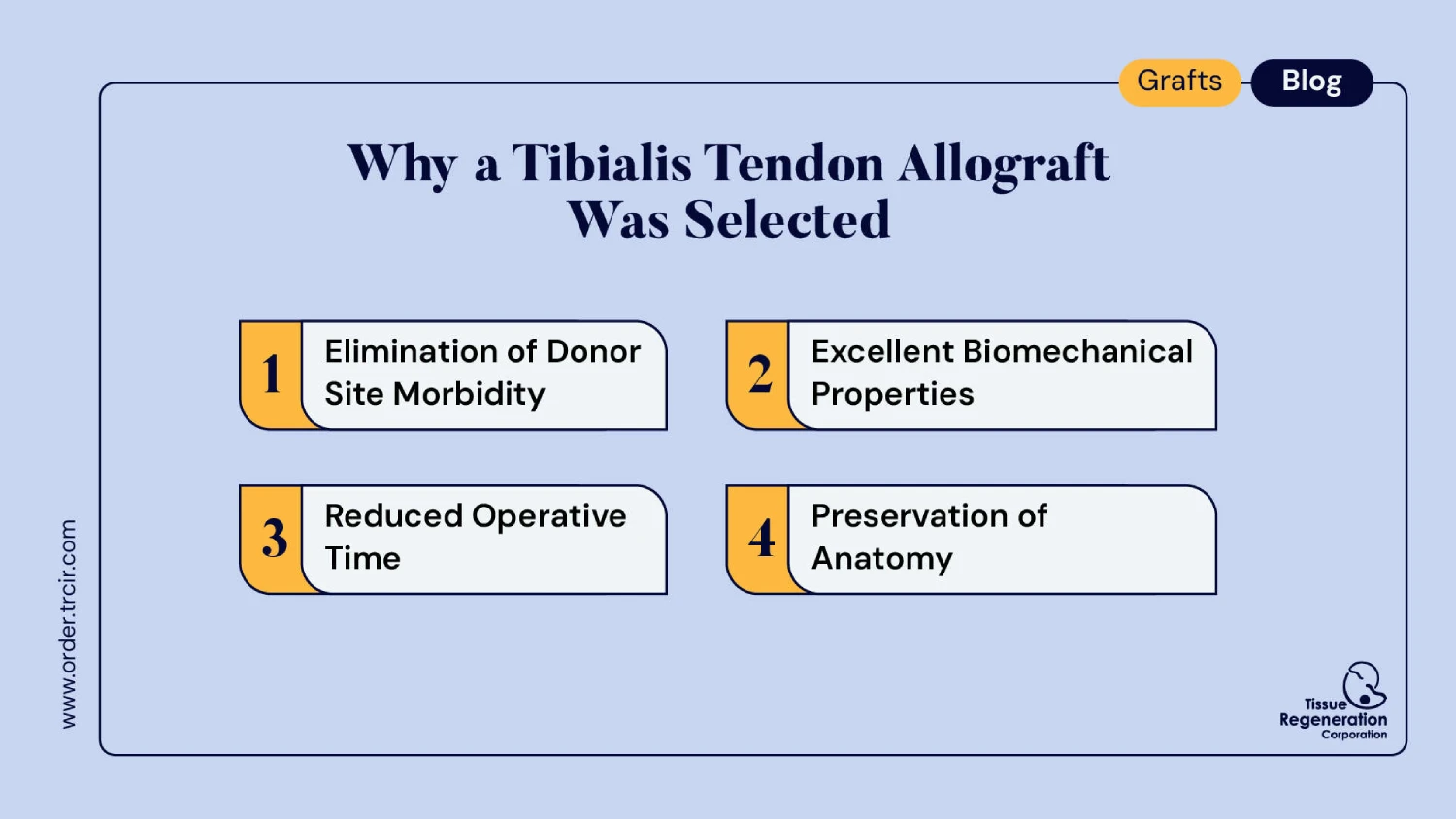
- Why a Tibialis Tendon Allograft Was Selected After considering the patient’s priorities—avoiding a second surgical site and a less painful rehabilitation—a tibialis tendon allograft was selected. The rationale was based on several key advantages:
- Elimination of Donor Site Morbidity: The primary motivator for the patient.
- Excellent Biomechanical Properties: The tibialis tendon allograft is known for its high tensile strength and stiffness, often exceeding that of the native ACL.
- Reduced Operative Time: Eliminating the graft harvest procedure shortens the overall surgery time.
- Preservation of Anatomy: Preserves the patient’s own tendons for any potential future procedures.

3. Surgical Procedure: Anatomic ACL Reconstruction
The patient underwent an arthroscopic anatomic ACL reconstruction using the selected tibialis tendon allograft.
- Graft Preparation: A pre-sized, Cryopreserved tibialis anterior tendon allograft was used. The graft was carefully thawed in a sterile saline solution as per the manufacturer’s protocol. It was then prepared to the appropriate diameter for the patient’s anatomy.
- Surgical Technique: Using standard arthroscopic portals, the remnants of the ruptured ACL were debrided. Anatomic tunnels were drilled in the femur and tibia. The prepared tibialis tendon allograft was then passed through the tunnels and secured with bio-absorbable interference screws.
4. Post-Operative Rehabilitation and Outcome
The patient began a structured, multi-phase rehabilitation protocol the day after surgery, progressing from pain control and range of motion to strengthening, plyometrics, and finally sport-specific drills.
- Long-Term Follow-up and Return to Sport At his 12-month post-operative follow-up, the patient reported excellent results with no pain or instability. Clinical examination demonstrated a stable knee. He successfully returned to recreational basketball with high confidence in his knee. His successful return to sport underscores the efficacy of his tibialis tendon allograft procedure, and he expressed high satisfaction with his decision.
5. Discussion: The Role of the Tibialis Tendon Allograft
This case successfully demonstrates the value of a tibialis tendon allograft for primary ACL reconstruction in a well-selected patient. Modern tissue processing has made allografts exceptionally safe. Studies on allograft success rates show excellent outcomes, particularly in patients over 25. For active individuals who prioritize avoiding donor site morbidity, the tibialis tendon allograft offers a reliable path to a stable knee and a successful return to an active lifestyle. This case serves as a clinical example of that successful pathway.
References
- Biomechanical Properties of Tibialis Tendons:
- Source: Pearsall, A. W., et al. (2003). A biomechanical comparison of three lower extremity tendons for ligament reconstruction. Journal of Surgical Orthopaedic Advances, 12(1), 35-39.
- Link
- Relevance: This study supports the selection of the tibialis tendon by demonstrating its strong biomechanical properties, which are suitable for ligament reconstruction.
- Systematic Review of Allograft vs. Autograft Outcomes:
- Source: Kaeding, C. C., et al. (2011). Allograft versus autograft anterior cruciate ligament reconstruction: predictors of failure from a MOON prospective longitudinal cohort. Sports Health, 3(1), 73-81.
- Link
- Relevance: A large-scale study from the MOON cohort that provides data on failure rates and helps guide the discussion on patient selection for allografts vs. autografts.
- Outcomes of Tibialis Allograft in ACL Reconstruction:
- Source: Medler, C. F., et al. (2018). Anterior Cruciate Ligament Reconstruction with Tibialis Allograft: A Matched-Cohort Analysis of a Single-Tendon, Double-Bundle Technique. The Journal of Bone and Joint Surgery, 100(2), 136-143.
- Link
- Relevance: This study specifically looks at the outcomes of using tibialis allografts for ACL reconstruction, showing favorable results and supporting its use as a viable graft choice.
- Allograft Safety and Processing:
- Source: Getelman, M. H., & Friedman, M. J. (1999). Sterilization of soft-tissue allografts. The American Journal of Sports Medicine, 27(5), 654-655.
- Link
- Relevance: This article discusses the critical importance of graft sterilization, a key factor in the safety and success of allograft procedures, aligning with the discussion on modern tissue processing.
- General Review on Graft Choices for ACL Reconstruction:
- Source: Legnani, C., et al. (2010). Graft choices for anterior cruciate ligament reconstruction. J Orthopaed Traumatol, 11(4), 197–204.
- Link
- Relevance: A comprehensive review that covers the pros and cons of various graft options, providing a strong foundation for the “Graft Selection Rationale” section of the case study.