

In the high-stakes world of healthcare and medical procurement, sourcing the right materials is not merely a logistical task; it is a direct contributor to patient safety and surgical outcomes. This is rarely truer than when procuring Acellular Dermal Matrix (ADM). As regenerative medicine becomes a cornerstone of complex wound care, breast reconstruction, and hernia repair, the demand for high-quality biological scaffolds has skyrocketed.
However, for hospital administrators, supply chain managers, and clinical directors, the market can feel overwhelming. There are numerous manufacturers, distributors, and tissue banks, each claiming to offer the superior product. But how do you distinguish between a vendor who simply moves boxes and a true partner dedicated to quality and reliability?
Choosing a reliable ADM supplier is about more than just comparing price sheets. It involves a deep dive into regulatory compliance, supply chain resilience, sterilization standards, and ethical sourcing.
In this guide from order.trcir.com, we will walk you through the essential criteria for selecting the right partner for your biological tissue needs. We will explore the red flags to avoid, the certifications that matter, and how to ensure that the product reaching your operating room is safe, effective, and available when your surgeons need it most.
If you are responsible for stocking these critical medical devices, stay with us. By the end of this article, you will have a clear checklist to evaluate your current or future partners.
Understanding the Landscape of ADM Procurement
Before we discuss how to choose, we must understand what we are buying. Acellular Dermal Matrices are biological tissues (either human allografts or animal xenografts) that have been processed to remove cells while retaining the structural matrix.
Because these are biological products, the supply chain is vastly different from synthetic meshes or surgical steel. The raw material is finite, the processing is delicate, and the storage requirements can be strict. Therefore, when you are looking for a reliable ADM supplier, you are looking for a company that has mastered the art of preserving biology while ensuring industrial-level consistency.
The market generally consists of two types of entities:
- Original Equipment Manufacturers (OEMs) / Tissue Banks: These entities process the tissue themselves.
- Specialized Distributors: Companies that curate high-quality products from various manufacturers to provide a central ordering hub for hospitals.
Both can be excellent partners, provided they meet specific rigorous standards.
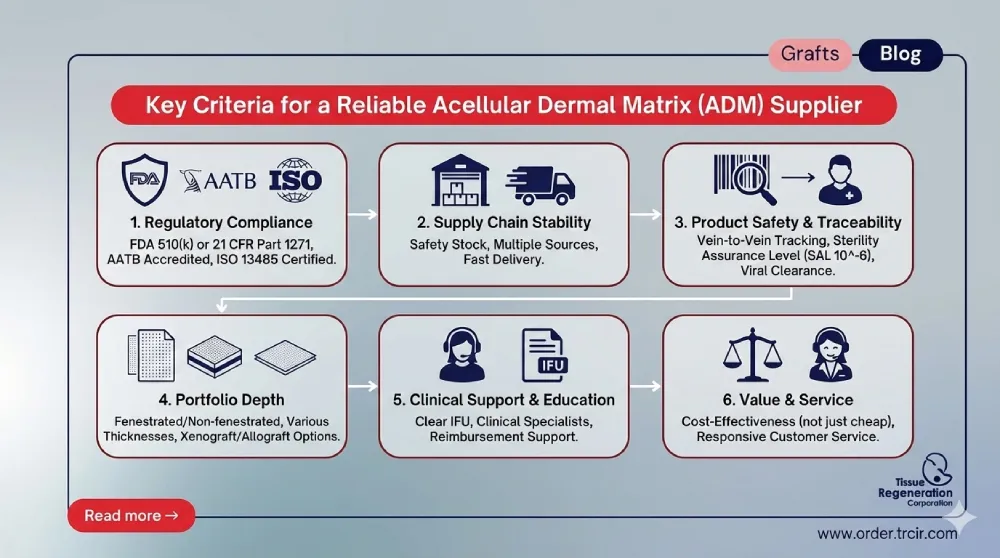
- Regulatory Compliance and AccreditationsA study by Gartner (2019) explored the global regulatory standards for biological implants, noting the importance of FDA 510(k) clearance and AATB accreditation for ensuring safety and effectiveness in ADM procurement. Compliance with these standards ensures that the ADM used in medical procedures is not only safe but also effective, minimizing the risks of complications post-surgery.
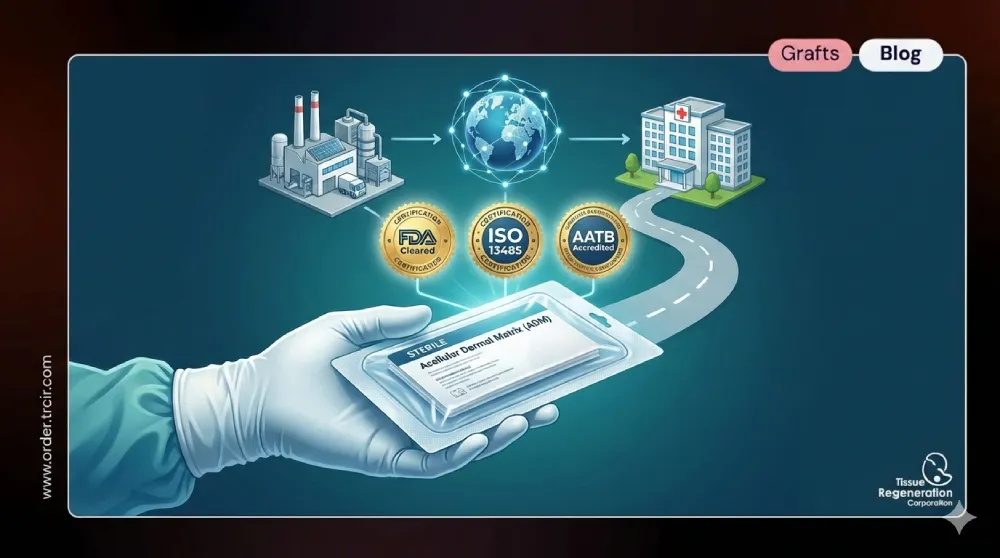
The very first filter in your search must be regulatory adherence. In the world of biological grafts, there is no room for error. A reliable ADM supplier must be transparent about their certifications.
FDA Registration and 510(k) Clearance
For xenografts (animal-derived) and synthetic-hybrid meshes, the supplier must provide FDA 510(k) clearance documentation, proving the device is substantially equivalent to a legally marketed device. For human tissue (allografts), they must be registered with the FDA as a tissue establishment under 21 CFR Part 1271.
AATB Accreditation
If you are procuring Acellular Dermal Matrix of human origin, check if the source is accredited by the American Association of Tissue Banks (AATB). This accreditation sets the gold standard for donor screening, tissue recovery, and processing safety.
ISO Standards
Look for ISO 13485 certification. This standard is specific to the medical device industry and indicates that the supplier has a comprehensive Quality Management System (QMS) in place. It ensures that every step, from storage at the warehouse to shipping to your facility, follows a documented, safe procedure.
- Supply Chain Stability and Inventory ManagementOne of the most pressing challenges in ADM procurement is ensuring the continuity of supply, especially when donor availability fluctuates. A recent paper by Pardes et al. (2018) highlighted how supply chain disruptions can lead to delays in complex surgeries like abdominal wall reconstructions. The study emphasizes the need for suppliers to maintain robust backup sources and safety stock to prevent such delays.
Imagine a surgeon is prepped for a complex abdominal wall reconstruction, only to find out the specific size of ADM required is on backorder. This is a nightmare scenario that a reliable ADM supplier works tirelessly to prevent.
Unlike synthetic materials, you cannot simply “print” more human tissue. Fluctuations in donor availability can impact supply. Therefore, when evaluating a partner like order.trcir.com, ask the following:
- Safety Stock Levels: Does the supplier maintain adequate inventory buffers to handle demand spikes?
- Diverse Sourcing: Do they rely on a single tissue bank, or do they have multiple validated sources to ensure continuity of supply?
- Delivery Speed: Can they offer overnight or same-day shipping for emergency cases?
A robust supplier understands that trauma and acute care do not run on a 9-to-5 schedule. They must have logistics in place that match the urgency of the clinical environment.
- Product Traceability and Safety
When procuring Acellular Dermal Matrix, you are introducing a foreign biological material into a patient’s body. Traceability is paramount.
A top-tier supplier should be able to track every single unit from the donor (or raw material source) to the final package sitting on your shelf. This is known as “vein-to-vein” or “source-to-surgeon” traceability.
- Sterility Assurance Level (SAL): Ask about their sterilization methods. Whether they use gamma irradiation, e-beam, or proprietary chemical sterilization, the industry standard is usually a SAL of 10^-6.
- Viral Clearance: The supplier should provide data on how their processing method inactivates viruses and bacteria.
- Adverse Event Reporting: A reliable ADM supplier will have a clear, compliant protocol for handling any adverse reaction reports, facilitating immediate communication between the manufacturer and the clinician.
- Range of Sizes and Types (Portfolio Depth)
Clinical needs vary wildly. A podiatrist treating a diabetic foot ulcer needs a small, thin graft. A plastic surgeon performing a breast reconstruction needs a large, contoured, and pliable sheet. A general surgeon repairing a massive hernia needs a thick, durable piece of tissue.
A limitation of many smaller suppliers is a lack of variety. When selecting a partner, look for a catalog that offers:
- Fenestrated and Non-Fenestrated options: Some wounds need drainage (fenestrated), while others need a solid barrier.
- Various Thicknesses: Ranging from thin (for superficial wounds) to thick (for load-bearing repairs).
- Xenograft vs. Allograft: Does the supplier offer both? Some patients may have religious or ethical objections to porcine (pig) or bovine (cow) tissue, requiring human tissue, and vice versa.
Platforms like order.trcir.com aim to centralize these options, allowing procurement officers to consolidate their purchasing orders rather than managing five different vendors for five different sizes.
- Clinical Support and Education
Procurement is not just about buying a box; it’s about buying a solution. The relationship shouldn’t end when the invoice is paid.
Advanced wound care products require specific handling and preparation. A reliable ADM supplier invests in education. This includes:
- Instructions for Use (IFU): Clear, accessible guidelines on how to hydrate, shape, and secure the matrix.
- Clinical Specialists: Access to knowledgeable representatives who can answer technical questions from surgeons.
- Reimbursement Support: ADMs are expensive, and billing for them can be complex. A good supplier helps your billing department understand the correct CPT and HCPCS codes to ensure the hospital is reimbursed for the materials used.
- Cost-Effectiveness vs. Cheap Pricing
There is a distinct difference between “cheap” and “cost-effective.” In the realm of procuring Acellular Dermal Matrix, the cheapest option is often the most dangerous.
Low-cost tissue might come from sources with less rigorous screening, or it might have poor handling characteristics that increase operating room time. If a graft fails because it was poor quality, the cost of the revision surgery and the extended hospital stay far outweighs the $500 saved on the initial purchase.
Focus on value. A reliable ADM supplier offers competitive pricing but backs it up with data showing low recurrence rates and high integration success. They should be willing to discuss volume-based pricing or contract pricing for facilities with high usage, striking a balance between budget constraints and clinical excellence.
- Storage and Handling Requirements
Before signing a contract, you must know the logistical burden the product will place on your facility.
- Shelf Life: Does the product have a 2-year shelf life or a 5-year shelf life? Longer shelf lives reduce the risk of inventory expiring and becoming waste.
- Temperature: Does the ADM require frozen storage (which is expensive and difficult to manage) or is it shelf-stable at room temperature?
- Hydration Time: Some ADMs require 20 minutes of soaking before use. Others are “ready-to-use” or pre-hydrated. This impacts OR efficiency.
Most modern supply chain managers prefer shelf-stable products that do not require expensive freezers or complicated tracking of temperature excursions during shipping.
The Role of Customer Service in Medical Procurement
Finally, never underestimate the human element. When things go wrong—and in logistics, they eventually do—you need a human on the other end of the phone.
A reliable ADM supplier is responsive. They communicate proactively about backorders rather than letting you find out on the day of surgery. They handle returns for expired or damaged goods with a fair policy. At order.trcir.com, we believe that transparency in communication is just as important as the quality of the product itself.
Frequently Asked Questions (FAQ)
To assist you further in your evaluation process, here are the most common questions procurement teams ask when selecting a tissue partner.
What is the difference between terminally sterilized and aseptically processed ADM?
Aseptically processed tissue is handled in a clean environment to prevent contamination, but it is not subjected to a final sterilization step like radiation. Terminally sterilized tissue undergoes a final process (like gamma irradiation) in its packaging to ensure a specific sterility assurance level (usually 10^-6). Many hospitals prefer terminally sterilized products for the added safety margin, though both are widely used.
How can we verify the source of the tissue?
Your supplier should be able to provide a “certificate of compliance” or similar documentation for each lot number. For human tissue, this tracks back to the donor recovery agency. For animal tissue, it tracks back to the specific herds and countries of origin (usually countries with low risk of BSE/mad cow disease).
Does the supplier assist with insurance reimbursement questions?
A high-quality reliable ADM supplier often has a reimbursement hotline or provides guides on the correct HCPCS (healthcare procedure coding system) codes (e.g., Q-codes) for their specific products. This ensures your facility does not lose money on the procedure.
What happens if the product arrives with damaged packaging?
You should never use a sterile medical device if the packaging is compromised. A reputable supplier will have a clear Return Merchandise Authorization (RMA) process to immediately replace damaged goods at no cost to you.
Is it better to buy direct from a manufacturer or through a distributor?
Both have pros and cons. Buying direct might save a small margin, but manufacturers only sell their own brand. Buying through a specialized distributor often gives you access to a wider range of products, centralized billing, and an unbiased recommendation on which product fits your specific clinical need best.
Conclusion
The responsibility of procuring Acellular Dermal Matrix is significant. You are the gatekeeper of the products that surgeons use to rebuild lives. It is a balance of science, logistics, finance, and ethics.
When searching for a reliable ADM supplier, look beyond the glossy brochure. Demand proof of regulatory compliance, investigate their supply chain redundancy, and evaluate their commitment to clinical support. The right partner will alleviate the stress of procurement, allowing your clinical team to focus on what they do best: healing patients.
At order.trcir.com, we understand the nuances of this complex market. We are dedicated to providing high-quality, compliant, and effective reconstructive solutions with the reliability your hospital demands. By following the guidelines in this article, you can make informed decisions that benefit your budget, your surgeons, and most importantly, your patients.
References
- American Association of Tissue Banks (AATB). (2021). Standards for Tissue Banking. 15th Edition.
- U.S. Food and Drug Administration (FDA). (2022). Regulatory Considerations for Human Cells, Tissues, and Cellular and Tissue-Based Products: Minimal Manipulation and Homologous Use.
- Gartner, W. (2019). Healthcare Supply Chain Management: Best Practices for Biological Implants.
- Association of periOperative Registered Nurses (AORN). (2020). Guidelines for Management of Tissue and Grafts.
- Pardes, A. M., et al. (2018). The economic impact of graft failure in complex abdominal wall reconstruction. Journal of Surgical Research.