
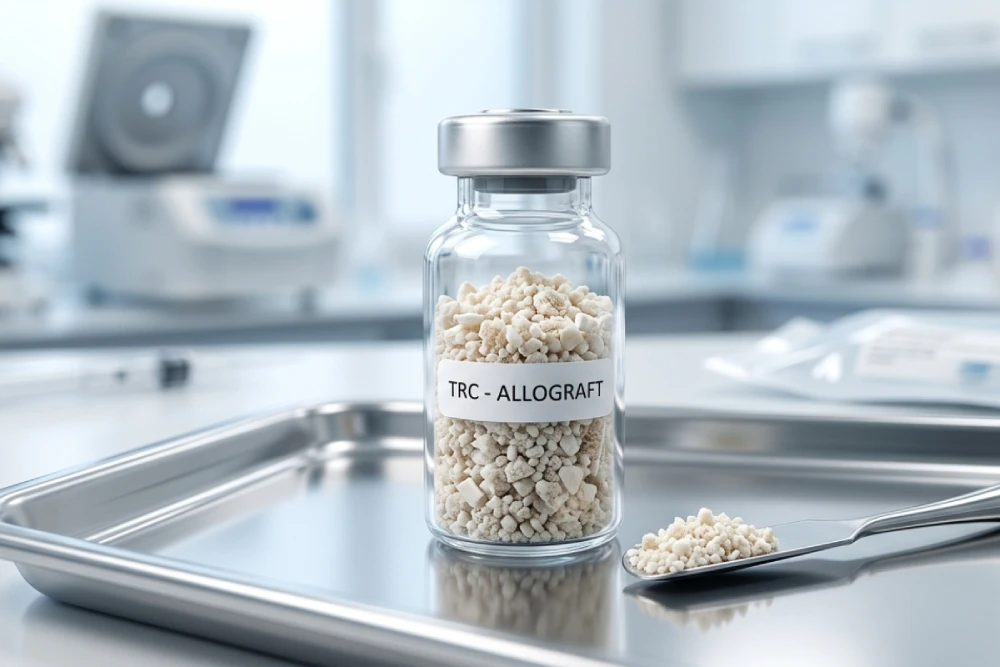
In the dynamic field of implant dentistry and oral surgery, the management of hard tissue is the foundation of functional and aesthetic success. Whether preparing a site for a future implant or reconstructing a defect caused by periodontal disease, the choice of grafting material is a critical decision for every clinician. Among the myriad of options available, the particulate bone graft remains the most versatile, predictable, and widely used solution in dental regenerative procedures.
At TRC (order.trcir.com), we understand that for periodontists, oral surgeons, and implantologists, the graft material is more than just a filler—it is the blueprint for future bone. In this comprehensive guide, we will delve into the science, selection, and clinical application of particulate allografts, ensuring you have the knowledge to select the best product for your patient’s specific needs.

Defining the Particulate Bone Graft
A particulate bone graft consists of ground or milled bone particles, typically ranging in size from 150 to 1000 microns (small particle) or 1000 to 2000 microns (large particle). Unlike block grafts, which provide immediate structural rigidity but require significant remodeling, particulate grafts offer a massive surface area. This increased surface area is key to their biological performance.
When packed into a defect, the spaces between the particles allow for rapid angiogenesis (blood vessel formation) and the migration of osteogenic cells. This structure serves as a scaffold that facilitates osteoconduction, leading to faster integration and turnover into the patient’s own vital bone.
The Science of Particle Size and Composition
For the discerning clinician sourcing from order.trcir.com, understanding the nuances of particle composition is essential. Particulate bone graft products generally fall into two main processing categories, often used in combination:
Mineralized vs. Demineralized
- Mineralized Allograft (FDBA): Freeze-Dried Bone Allograft retains the natural mineral structure (hydroxyapatite). It is osteoconductive and resorbs slowly. This makes it ideal for maintaining space and volume, particularly in the aesthetic zone where collapsing buccal plates are a concern.
- Demineralized Allograft (DFDBA): Demineralized Freeze-Dried Bone Allograft undergoes an acid wash to remove minerals, exposing the underlying collagen matrix and Bone Morphogenetic Proteins (BMPs). This makes the graft osteoinductive, capable of stimulating bone formation more aggressively.
Cortical vs. Cancellous
- Cortical Particles: Dense and slow-resorbing. They maintain space for a long time, providing excellent mechanical stability.
- Cancellous Particles: Porous and spongy. They allow for rapid revascularization and quick remodeling but offer less space maintenance.
The Golden Ratio: Many experienced surgeons prefer a particulate bone graft that is a blend. A common mix found at TRC is 50% cortical (for volume stability) and 50% cancellous (for fast healing), or a 70/30 mix depending on the indication.
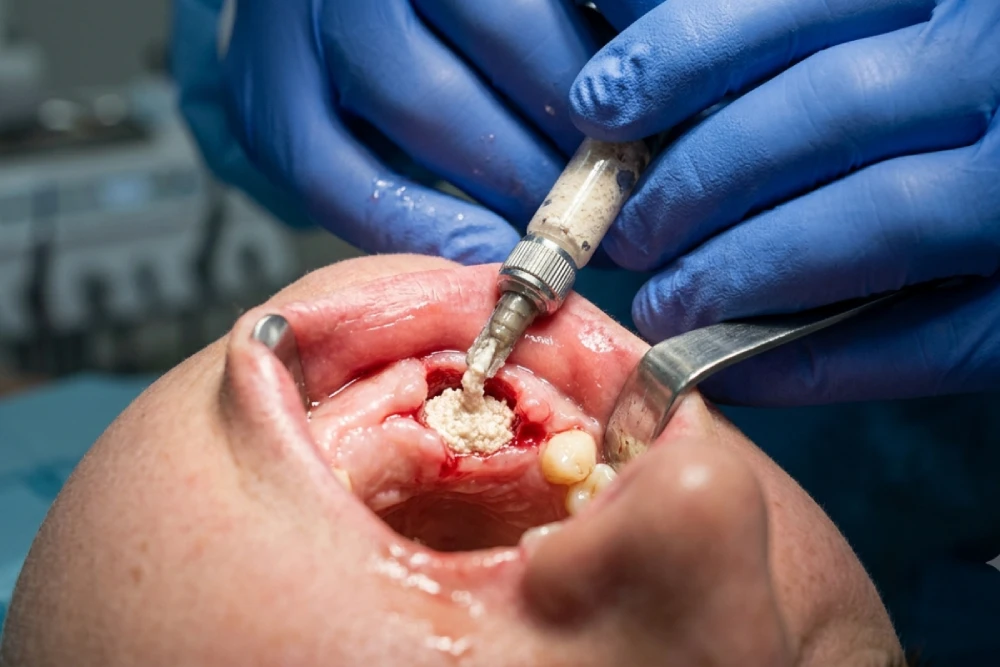
Clinical Indications for Particulate Allografts
The versatility of the particulate bone graft allows it to be the “Swiss Army Knife” of dental bone regeneration.
- Socket Preservation (Ridge Preservation)
Following an extraction, the alveolar ridge inevitably undergoes resorption. Placing a particulate bone graft into the socket immediately after extraction is the standard of care to preserve bone width and height. A mineralized cortical/cancellous mix is typically preferred here to prevent the collapse of the socket walls while the site heals for future implant placement.
- Sinus Floor Elevation (Sinus Lift)
In the posterior maxilla, available bone height is often limited by the maxillary sinus. A lateral or crestal approach sinus lift creates a space that must be filled to support implants. Particulate bone graft material is ideal here because it can be packed easily into the irregular geometry of the sinus cavity. The graft eventually consolidates, forming a solid bony foundation.
- Ridge Augmentation
For horizontal or vertical defects, particulate grafts are often used in conjunction with barrier membranes (Guided Bone Regeneration or GBR). The particles fill the defect, and the membrane prevents soft tissue ingrowth, allowing the bone to regenerate undisturbed.
- Periodontal Defects
In cases of intrabony defects caused by periodontal disease, using a fine-particle particulate bone graft (often DFDBA) can help regenerate the lost attachment apparatus, stabilizing the tooth and reducing pocket depth.
Why Choose Allograft Particulates Over Other Sources?
While autografts (patient’s own bone), xenografts (bovine/porcine), and synthetics are available, allograft particulate bone graft options from TRC offer distinct advantages:
- No Donor Site Morbidity: Unlike autografts, there is no need to harvest bone from the patient’s chin or ramus, reducing pain and chair time.
- Human Collagen Match: unlike xenografts, allografts are human tissue. The collagen structure is identical to the host, which can facilitate more predictable remodeling compared to cross-species grafts that may remain encapsulated.
- Availability: We provide varying volumes (0.5cc, 1cc, etc.) to suit specific procedures, ensuring you open only what you need, making it a cost-effective choice for the clinic.

Handling and Surgical Techniques
To maximize the success of a particulate bone graft, proper handling is crucial.
- Hydration: Allografts from TRC are typically freeze-dried. They must be rehydrated with sterile saline or the patient’s blood prior to placement. This improves handling and initiates the release of growth factors.
- Sticky Bone Concept: Many modern surgeons mix the particulate graft with Platelet-Rich Fibrin (PRF) or Platelet-Rich Plasma (PRP). This creates a “sticky bone” consistency that is easier to mold and provides a massive boost of growth factors to the site.
- Packing Density: The graft should be packed firmly to ensure particle-to-particle contact but not so tightly that blood supply is choked off. A well-vascularized graft is a successful graft.
Safety and Quality Assurance at TRC
Safety is the paramount concern in dental implantology. At TRC, our particulate bone graft products undergo rigorous screening and sterilization. Our processing methods ensure the removal of antigenicity while preserving the biological integrity of the matrix. When you order from order.trcir.com, you are receiving tissue that meets the highest international standards for tissue banking.
Frequently Asked Questions (FAQ)
What is the difference between FDBA and DFDBA particulate grafts?
FDBA (Freeze-Dried Bone Allograft) is mineralized. It is harder, radiopaque, and resorbs slowly, making it excellent for space maintenance. DFDBA (Demineralized) has the mineral removed to expose growth factors, making it osteoinductive but less structural. Often, a blend of both is used to get the benefits of both types.
How much particulate bone graft is needed for a single molar extraction socket?
Typically, a single molar extraction socket requires between 0.5cc to 1.0cc of particulate bone graft. However, this depends on the size of the roots and whether there is any associated pathology (cystic lesions) that has enlarged the defect.
How long does it take for particulate allograft to turn into bone?
The healing time depends on the patient’s physiology and the type of graft. A predominantly cancellous graft may be ready for implant placement in 3-4 months. A cortical-heavy graft used for ridge preservation generally requires 4-6 months to mature sufficiently to support the torque of an implant.
Can I mix particulate bone graft with antibiotics?
Yes, some clinicians mix the dry particles with a liquid antibiotic solution (like clindamycin or tetracycline) instead of saline, especially if the site had a previous infection. However, this is a clinical judgment call. Standard hydration with sterile saline or blood is usually sufficient for clean sites.
Is a membrane always required when using particulate grafts?
In most cases, yes. Because particulate bone graft is loose, it needs containment. A collagen membrane or a pericardium membrane prevents the fast-growing gum tissue (epithelium) from migrating into the graft site, ensuring that the slower-growing bone cells have time to populate the scaffold.
Conclusion
The particulate bone graft is an indispensable tool in the arsenal of the modern dental surgeon. Its ability to adapt to complex defect shapes, coupled with its potent biological potential, makes it the standard for ridge preservation and augmentation.
For dental professionals seeking reliable, high-quality, and biologically safe regenerative materials, TRC stands as a trusted partner. Our commitment to excellence ensures that every vial of graft material you open contributes to a predictable and successful surgical outcome.
Visit order.trcir.com today to explore our range of particulate allografts, from cortical-cancellous blends to specialized DBM putties, and elevate your practice’s regenerative capabilities.
References:
- Wang, H. L., & Boyapati, L. “PASS principles for predictable bone regeneration.” Implant Dentistry (2006).
- Beck, T. M., & Mealey, B. L. “Histologic analysis of healing after tooth extraction with ridge preservation using mineralized human bone allograft.” Journal of Periodontology (2010).
- Misch, C. E. “Contemporary Implant Dentistry.” Elsevier Health Sciences (2007).
- Eskan, M. A., et al. “The effect of particle size of bone graft on alveolar ridge preservation.” Journal of Oral Implantology (2016).