
Introduction: Preserving the Blueprint of Life for Surgical Reconstruction
In the revolutionary field of regenerative medicine, allografts—human tissue grafts from a donor—stand as a testament to the power of science in restoring form and function. From rebuilding a jawbone for a dental implant to performing a complex spinal fusion, these grafts are indispensable. However, the journey of a tissue graft from a donor to a recipient is fraught with challenges. The primary obstacle is preserving its delicate biological structure and ensuring absolute safety outside the sterile environment of the human body.
This is where lyophilization, a sophisticated freeze-drying process, emerges as a cornerstone of modern tissue processing technology. Far more complex than simple dehydration, the lyophilization of human tissue is a meticulous, science-driven method that transforms a fragile biological material into a stable, safe, and effective surgical tool. This guide will provide a comprehensive exploration of the science behind lyophilization, detailing how it critically enhances allograft safety standards and optimizes the clinical performance of products like freeze-dried bone allograft (FDBA), making them a reliable choice in operating rooms worldwide.
What is Lyophilization? The Science of Sublimation in Medicine
Lyophilization, at its core, is a process of removing water from a product after it is frozen and placed under a vacuum. Unlike heat-based drying methods that would destroy a delicate biological structure, lyophilization allows water to pass directly from a solid state (ice) to a gaseous state (vapor) without ever entering a liquid phase. This process, known as sublimation, is the key to preserving the intricate microarchitecture of tissue grafts.
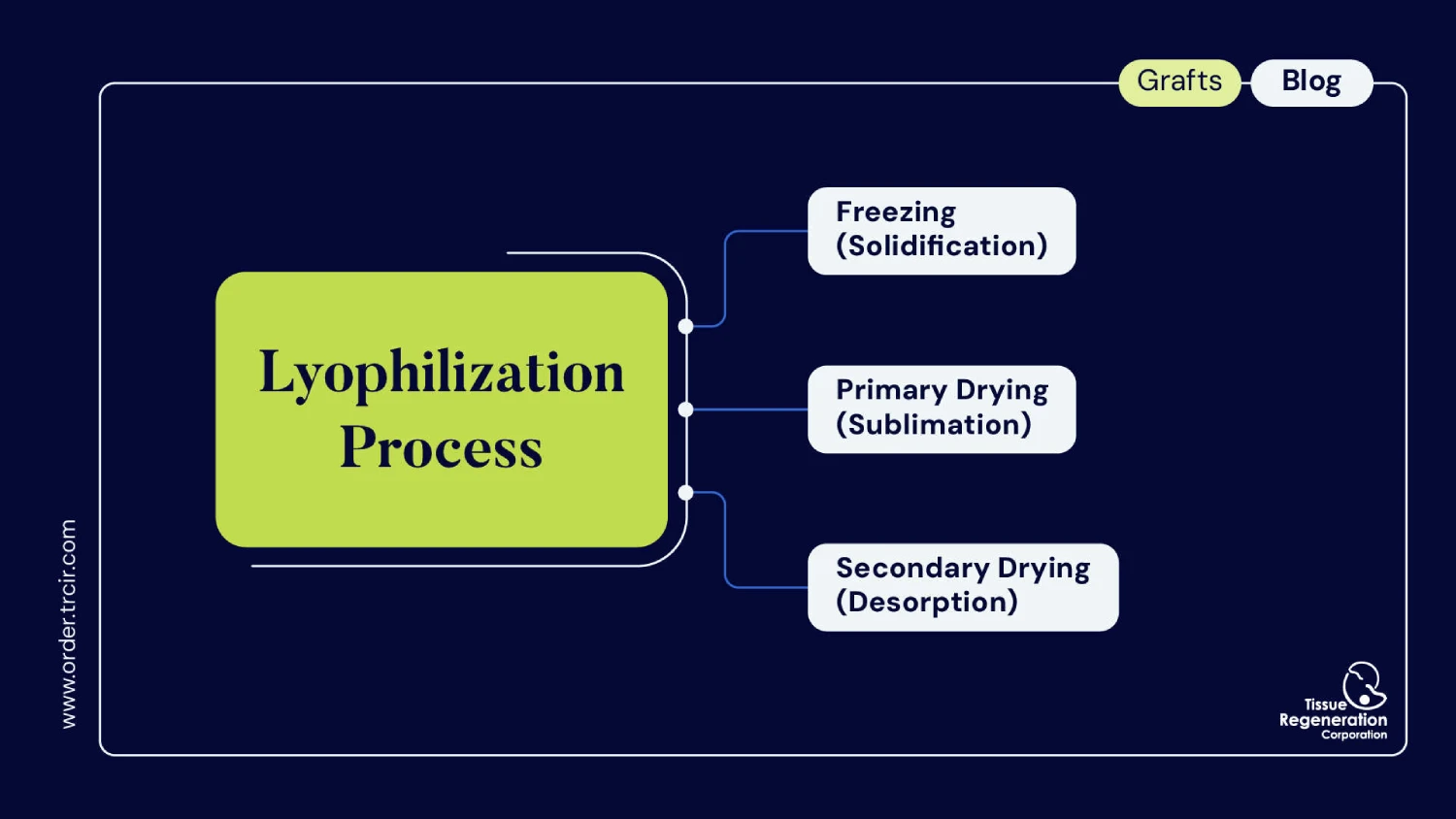
The process is meticulously controlled and occurs in three distinct stages:
Stage 1: Freezing (Solidification)
This is the foundational step. The tissue graft is placed in a highly controlled environment and its temperature is lowered to well below the freezing point (typically -40°C to -50°C). The rate of freezing is critical; it must be carefully managed to control the size of the ice crystals that form. Large, sharp ice crystals can damage the collagen matrix of the tissue, compromising its final structural integrity. Therefore, precise control during this stage is paramount.
Stage 2: Primary Drying (Sublimation)
Once frozen, the graft is subjected to a deep vacuum, far below normal atmospheric pressure. Energy, in the form of heat, is then slowly and carefully applied. This energy gives the frozen water molecules enough power to break free and sublime, turning directly into vapor. This vapor is then collected on a condenser within the lyophilizer. This stage removes about 95% of the water from the tissue, all while the underlying structure remains locked in a frozen, solid state, perfectly preserving its shape and porosity.
Stage 3: Secondary Drying (Desorption)
After the primary drying phase, a small amount of water molecules remains bound to the tissue matrix. The temperature is gradually raised (while still under vacuum) to break these bonds and remove the final residual moisture. This stage is crucial for ensuring the long-term stability of the final product, as residual moisture can lead to degradation over time. The end result is a graft that is approximately less than 5% water by weight, making it biologically inert and incredibly stable.
The Paramount Advantage: Enhancing Allograft Safety Standards
For any surgeon or hospital, the primary consideration for an allograft is safety. Lyophilization plays a direct and vital role in elevating the safety profile of tissue grafts, working in synergy with other quality control measures.
Inhibiting Pathogen Growth through an Inhospitable Environment
The process itself creates an environment where microorganisms cannot survive. The extreme cold of the freezing stage and the deep vacuum of the drying stages are inhospitable to bacteria and viruses. While lyophilization is not considered a terminal sterilization method on its own, it is a critical step in the “aseptic chain,” significantly reducing the bioburden of the tissue before the final sterilization step.
Optimizing Terminal Sterilization of Tissue Grafts
This is one of the most significant safety benefits. After packaging, allografts must undergo a final, terminal sterilization, commonly using low-dose gamma irradiation. The presence of water during irradiation can lead to the formation of hydroxyl free radicals, which can severely damage the tissue’s delicate collagen matrix, weakening its mechanical strength and impairing its biological function.
Because a lyophilized graft is profoundly dehydrated, the damaging effects of irradiation are dramatically reduced. This allows for a sufficient dose of radiation to ensure sterility while preserving the crucial biomechanical and osteoconductive properties of the graft. In essence, lyophilization makes the graft a better, more resilient candidate for the final, critical safety step.
Reducing the Potential for an Immunogenic Response
A recipient’s immune system can sometimes react to foreign proteins in a graft. The rigorous processing that occurs before lyophilization, including the removal of blood, marrow, and other cellular components, strips away many of the antigens that could trigger such a response. Furthermore, the freeze-drying process can alter the surface antigens of the allograft, potentially reducing its immunogenicity. The result is a graft that is more biocompatible and less likely to cause an inflammatory reaction, leading to smoother acceptance and integration by the host’s body.
Optimizing Clinical Efficacy: The Surgical Benefits of Lyophilized Grafts
Beyond safety, lyophilization imparts a range of practical, clinical advantages that enhance the graft’s performance and usability in the operating room.
Exceptional Stability: Extended Shelf Life and Ambient Storage
This is a game-changing logistical advantage. Cryopreserved (deep-frozen) tissues require specialized, ultra-low temperature freezers and complex thawing protocols. In contrast, lyophilized grafts are shelf-stable at room temperature for up to five years. This simplifies inventory management for hospitals, eliminates the risk of spoilage from power outages, and makes the graft immediately accessible when needed.
Preserving the All-Important Biomechanical Scaffold
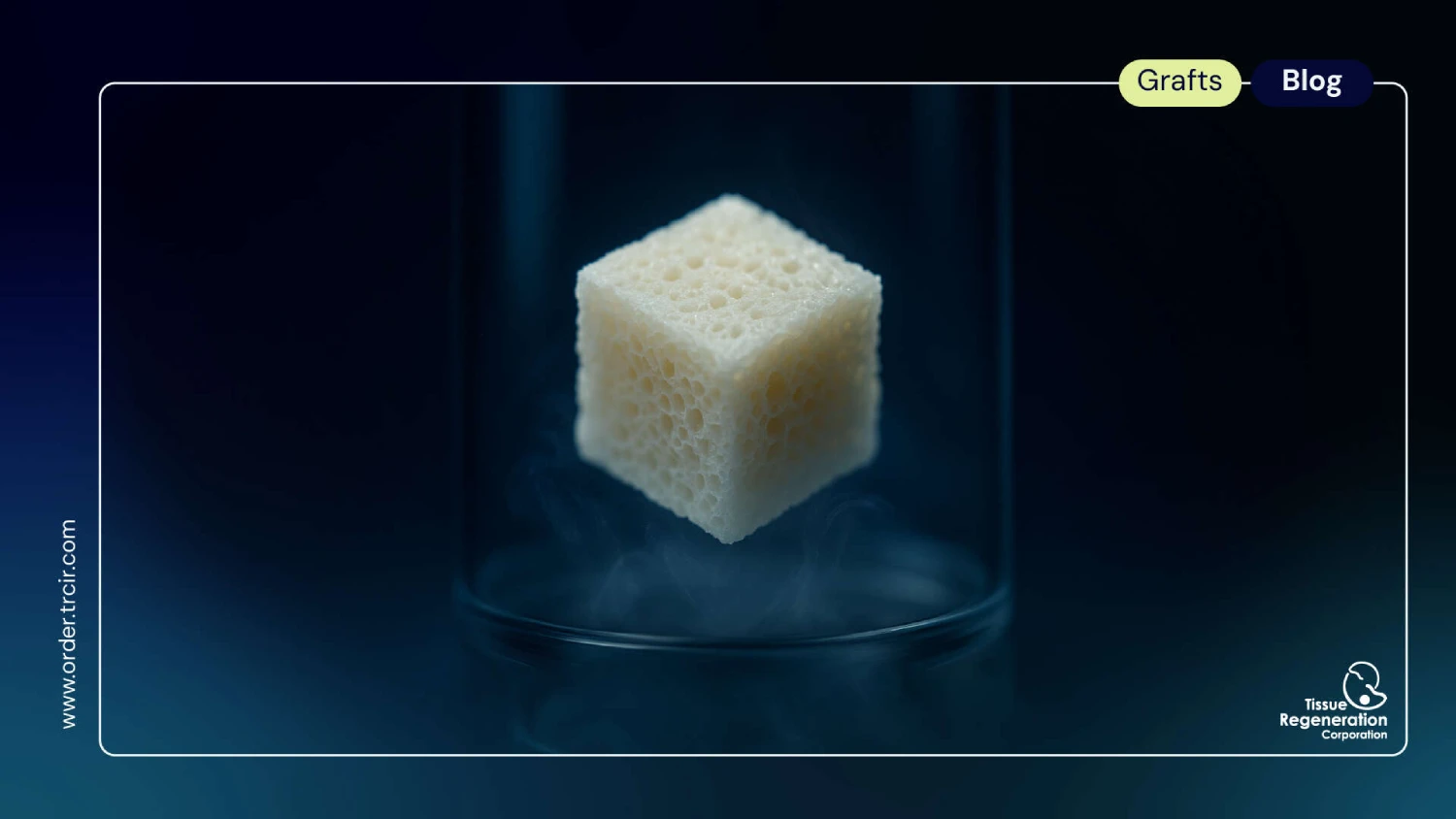
The primary function of most bone grafts is to serve as an osteoconductive scaffold. Lyophilization excels at preserving this intricate, porous microarchitecture. By avoiding the damaging forces of liquid water and heat, the process maintains the native structure of the collagen and mineral matrix. For a freeze-dried bone allograft (FDBA), this means the interconnected network of pores and channels remains intact, creating an ideal environment for the recipient’s cells, blood vessels, and growth factors to infiltrate, anchor, and begin the process of new bone formation.
Predictable and Efficient Rehydration
The porous structure created by the sublimation of ice crystals acts like a high-tech sponge. In the operating room, a surgeon can rehydrate a lyophilized graft in seconds to minutes using sterile saline, the patient’s own blood, or potent biologics like Bone Marrow Aspirate (BMA) (Although the manufacturer recommends rehydration for minimum of 20 minutes.). This rehydration is quick, uniform, and predictable, restoring the graft’s natural handling characteristics and preparing it for implantation.
Versatility as a Carrier for Bioactive Agents
The dry, porous nature of a lyophilized graft makes it an ideal carrier vehicle. Surgeons can leverage this property to create a customized, combination graft at the point of care. The scaffold can be soaked with antibiotics to prevent infection, growth factors (like BMPs) to boost its osteoinductive potential, or the patient’s own stem cells from BMA to add a powerful osteogenic component. This turns a passive scaffold into an active, biology-enhancing surgical tool.
Conclusion: The Unsung Hero of Modern Allograft Technology
In the complex world of regenerative medicine, lyophilization stands out as a quiet but indispensable technology. It is the scientific foundation upon which the safety, stability, and efficacy of modern allografts are built. By meticulously removing water while preserving the delicate biological blueprint, this process overcomes the fundamental challenges of tissue preservation.
The result is a product that is not only safer—by reducing immunogenicity and enabling more effective sterilization—but also clinically superior. With a multi-year shelf life, preserved biomechanical structure, and versatile handling characteristics, lyophilized grafts like FDBA provide surgeons with a predictable and powerful tool for reconstruction. For any clinician or healthcare provider, understanding the science of lyophilization of human tissue is to understand the deep commitment to quality and safety embedded in every graft they use.
References
- Science of Lyophilization (General Principle):
- Source: Jennings, T. A. (2018). Lyophilization: Introduction and Basic Principles. CRC Press. This text provides a foundational understanding of the physics of sublimation and the three stages of the freeze-drying process.
- Link
- Lyophilization in Tissue Banking:
- Source: G V, S., & S, D. (2014). Freeze drying of biological specimens. Journal of Applied & In-Vitro Fertilization, 3(113). This article discusses the application of freeze-drying for preserving biological materials, including tissues, for medical use.
- Link
- Effects of Sterilization on Lyophilized Tissue:
- Source: Nguyen, H., Morgan, D. A., & Forwood, M. R. (2007). Sterilization of allograft bone: effects of gamma irradiation on allograft incorporation and mechanical properties. Cell and Tissue Banking, 8(2), 93–105. This study explores how gamma irradiation affects bone grafts, noting that the effects are moderated in dehydrated (lyophilized) tissues compared to hydrated ones.
- Link
- Preservation of Biomechanical Scaffold (FDBA):
- Source: Werdin, F., et al. (2009). Lyophilization of acellular dermal matrix: a comparison of different methods. Annals of Transplantation, 14(2), 31-38. This paper compares different lyophilization methods and their impact on the structural integrity of the dermal matrix, highlighting the importance of preserving the scaffold.
- Link
- Clinical Application and Rehydration:
- Source: Gruskin, E., et al. (2012). Demineralized bone matrix in bone repair: History and future. Advanced Drug Delivery Reviews, 64(12), 1063-1077. This review discusses the properties of DBM (often lyophilized) and its role as an osteoconductive and osteoinductive scaffold in bone repair.
- Link
Frequently Asked Questions (FAQ)
- Is lyophilization the same as just freezing tissue? No. Freezing is only the first step. The critical part of lyophilization is the subsequent removal of the frozen water under a vacuum through sublimation. Simple freezing does not remove water and does not result in a shelf-stable product.
- Does lyophilization sterilize the tissue? No, lyophilization itself is not a terminal sterilization method. However, it is a key part of the overall safety process that reduces bioburden and, most importantly, prepares the tissue to safely undergo terminal sterilization (like gamma irradiation) with minimal damage to its structure.
- How does a freeze-dried graft turn back into bone? The freeze-dried graft acts as an osteoconductive scaffold. After it is rehydrated and implanted, the patient’s own blood vessels and bone-forming cells grow into the graft’s porous structure. Over a period of months, the body gradually breaks down and resorbs the graft material while simultaneously replacing it with new, living bone in a process called “creeping substitution.”
- Why is a freeze-dried bone allograft (FDBA) often preferred over a simple frozen allograft? FDBA is preferred for several key reasons: it is shelf-stable at room temperature for years (no special freezers needed), it has a lower potential for an immune response, and it withstands terminal sterilization with less structural damage, leading to a safer and more predictable clinical product.
- Does the freeze-drying process damage the growth factors (BMPs) in the bone? The process can reduce the activity of some sensitive proteins. However, the demineralization step used to create osteoinductive grafts (like DFDBA) is designed to protect and expose these growth factors. While some potency may be lost compared to fresh tissue, enough is preserved to confer a clinically significant osteoinductive effect.
- How long can a lyophilized tissue graft be stored? Thanks to the extremely low residual moisture content, lyophilized allografts are incredibly stable. Most tissue banks validate them for a shelf life of up to five years when stored in their sterile packaging at ambient room temperature.