
The landscape of Anterior Cruciate Ligament (ACL) reconstruction has evolved significantly over the last few decades. While the “gold standard” has traditionally been the use of autografts, the clinical demand for reduced donor-site morbidity and faster recovery times has propelled the search for effective alternatives to autograft in ACL surgery. For surgeons and clinical suppliers at TRC (Tissue Regeneration Corporation), understanding these alternatives is not just about expanding surgical options; it is about optimizing patient outcomes and streamlining the efficiency of the operating room.
In modern sports medicine, the choice of graft is a nuanced decision influenced by the patient’s age, activity level, and previous surgical history. As the medical community moves toward more minimally invasive techniques, the role of high-quality allografts and synthetic options becomes increasingly prominent. This article explores the various biological and technological substitutes available today, highlighting why many practitioners are shifting their preference toward advanced tissue solutions.
The Limitations of Autografts
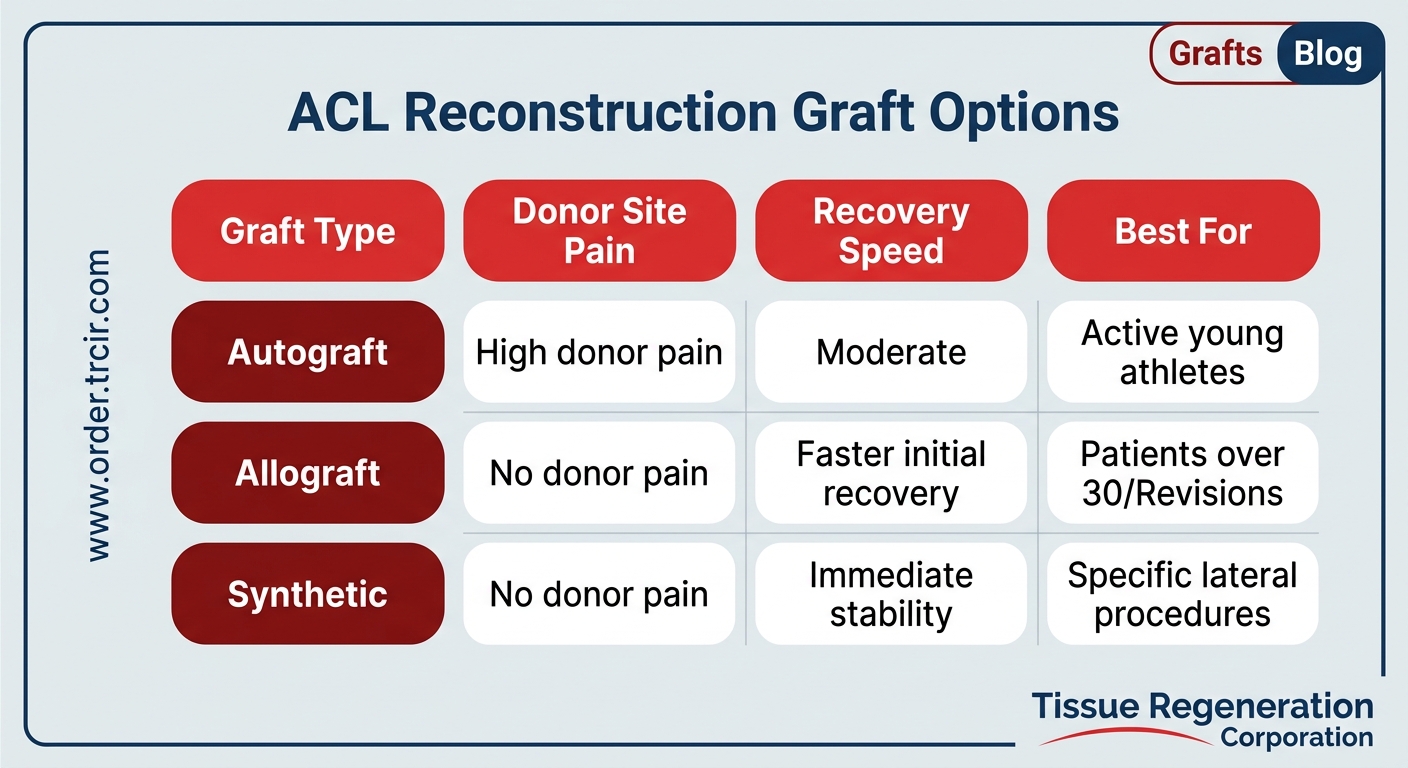
Before diving into the alternatives, it is essential to acknowledge why surgeons seek them. Autografts, typically harvested from the patellar tendon, hamstring, or quadriceps, require a secondary surgical site. This often leads to “donor-site morbidity,” characterized by chronic pain, kneeling discomfort, and potential weakening of the muscle group from which the tissue was taken. For high-demand athletes or older patients who cannot afford prolonged rehabilitation, these drawbacks make alternatives to autograft in ACL surgery a highly attractive proposition.
Allografts: The Leading Biological Alternative
Allografts, or human donor tissues, represent the most widely used alternative to autografts. At TRC, we specialize in the meticulous processing of these tissues to ensure they meet the highest safety and functional standards. Allografts offer several distinct advantages that are particularly valuable in a clinical setting.
One of the primary benefits is the elimination of donor-site pain. Because the tissue is sourced from a cadaveric donor, the surgeon does not need to harvest the patient’s own healthy tissue. This results in smaller incisions, less postoperative pain, and a more predictable recovery timeline. Furthermore, allografts allow for shorter operative times, which is a critical factor for hospital efficiency and reducing anesthesia-related risks for the patient.
Types of Allografts Used in ACL Reconstruction
Several types of allografts are commonly utilized as alternatives to autograft in ACL surgery:
- Bone-Patellar Tendon-Bone (BTB): Highly valued for its bone-to-bone healing properties, providing rigid fixation.
- Achilles Tendon: Offers a large cross-sectional area and a bone block on one end, making it excellent for revision surgeries.
- Tibialis Anterior/Posterior: Popular for their strength and ease of passage through surgical tunnels.
- Hamstring Allografts: Provide a versatile option for surgeons who prefer soft-tissue-to-bone healing.
Advancements in sterilization, such as low-dose gamma irradiation and proprietary chemical washes used by providers like TRC, have significantly mitigated the historical concerns regarding disease transmission and graft weakening. Modern allografts maintain structural integrity while ensuring biological safety.
Synthetic Grafts: History and Modern Resurgence
Synthetic grafts have a checkered history in orthopedics. In the 1980s, early versions often failed due to fatigue and chronic inflammation. However, the field has seen a resurgence with the development of “Ligament Advanced Reinforcement Systems” (LARS) and bio-resorbable scaffolds.
These alternatives to autograft in ACL surgery act as a temporary bridge, allowing the patient’s own cells to infiltrate and eventually replace the synthetic fibers. While they are currently used more frequently in Europe and for specific lateral extra-articular tenodesis procedures, they represent a growing frontier in ACL reconstruction technology.
Xenografts: Exploring Animal-Derived Tissues
Xenografts, typically derived from bovine (cow) or porcine (pig) sources, are another area of active research. The main challenge with xenografts is the immunogenic response—the human body’s tendency to reject foreign animal tissue. Recent breakthroughs in decellularization and alpha-gal removal have made these grafts more viable, though they are still less common than human allografts in standard ACL procedures.
Bio-Engineered Scaffolds and Growth Factors
The future of alternatives to autograft in ACL surgery lies in regenerative medicine. Bio-engineered scaffolds, often combined with Platelet-Rich Plasma (PRP) or Bone Marrow Aspirate Concentrate (BMAC), aim to stimulate the body’s natural healing response. These scaffolds provide a three-dimensional structure that guides the formation of new ligamentous tissue. While still in various stages of clinical trials, this “biological augmentation” is becoming a standard adjunct to allograft procedures to enhance graft incorporation and “ligamentization.”
Clinical Decision-Making: Choosing the Right Alternative
The selection of alternatives to autograft in ACL surgery is not a one-size-fits-all approach. Surgeons must consider the following factors:
- Patient Age: Allografts are highly successful in patients over 30 or 40 who are looking to return to a healthy, active lifestyle without the burden of donor-site pain.
- Surgical History: In revision ACL cases where previous autografts have been exhausted, allografts provided by companies like TRC are often the only viable solution.
- Activity Level: For recreational athletes, the differences in rupture rates between autografts and high-quality allografts have narrowed significantly, making allografts a preferred choice for many.
Why TRC is Your Partner in ACL Reconstruction
As a leader in the field of human tissue recovery and processing, TRC (Tissue Regeneration Corporation) provides surgeons with the high-quality allografts necessary to perform successful ACL reconstructions. Our commitment to safety and biological excellence ensures that our alternatives to autograft in ACL surgery meet the rigorous demands of modern orthopedic clinics and hospitals. By choosing TRC, practitioners can focus on surgical precision while we provide the foundational biological materials needed for patient recovery.
FAQ: Alternatives to Autograft in ACL Surgery
Are allografts as strong as autografts for ACL surgery?
Modern studies indicate that in terms of initial tensile strength, high-quality allografts are comparable to autografts. While the “ligamentization” process (the body incorporating the graft) may take slightly longer with an allograft, the clinical outcomes for the majority of patients are excellent, particularly when using tissues processed with advanced safety protocols.
What is the main advantage of using an allograft instead of my own tissue?
The primary advantage is the lack of donor-site morbidity. By choosing alternatives to autograft in ACL surgery such as allografts, patients avoid complications like patellar fracture, chronic kneeling pain, or hamstring weakness, often leading to an easier early rehabilitation phase.
Is there a risk of disease transmission with allografts?
The risk is extremely low due to stringent donor screening and advanced sterilization techniques used by tissue banks like TRC. Modern processing methods effectively eliminate bacteria and viruses while preserving the mechanical properties of the tendon.
How do synthetic grafts differ from allografts?
Allografts are biological tissues derived from human donors that eventually undergo a process of cellular infiltration and remodeling by the patient’s body. Synthetic grafts are man-made materials designed to provide immediate mechanical stability, though they do not always integrate biologically in the same way as human tissue.
Which allograft is best for a revision ACL surgery?
The Achilles tendon allograft is often favored for revision surgeries because it provides a large amount of tissue and a bone block, which is helpful if the original surgical tunnels have widened.
Is recovery faster with an allograft?
While the biological healing of the graft into the bone takes a similar amount of time, the initial postoperative recovery is often perceived as “faster” or “easier” because the patient does not have to recover from the trauma of a second surgical site where the graft would have been harvested.
References:
- Smith, P. A., & Bley, J. P. (2023). Allograft vs. Autograft in ACL Reconstruction: A Meta-Analysis of Recent Clinical Outcomes. Journal of Bone and Joint Surgery.
- Miller, R. H., et al. (2024). Donor-Site Morbidity Following Autograft Harvest: A 10-Year Follow-up Study. American Journal of Sports Medicine.
- Tissue Regeneration Corporation (TRC) Internal Data (2025). Safety and Efficacy Standards for Human Allograft Processing.
- Johnson, D. L. (2022). Synthetic Scaffolds in Ligament Reconstruction: From Failures to Future Frontiers. Clinics in Sports Medicine.
- World Health Organization (WHO). Guiding Principles on Human Cell, Tissue and Organ Transplantation.