

Introduction: The Cornerstone of Reconstruction—Choosing the Optimal Bone Graft
In the intricate world of orthopedic, neurosurgical, and maxillofacial surgery, bone grafting remains a fundamental procedure for promoting skeletal healing, providing structural support, and restoring function. The success of countless reconstructive surgeries hinges on one critical decision: the selection of the appropriate bone graft. For decades, surgeons have weighed the benefits and drawbacks of the two primary bone grafting options: the autograft, sourced from the patient’s own body, and the allograft, derived from a human donor.
While the autograft has long been hailed as the “gold standard” due to its intrinsic biological properties, the evolution of tissue processing and sterilization has positioned the allograft as a formidable and often more practical alternative. This guide provides a comprehensive, evidence-based comparison of allograft vs. autograft, designed to equip surgeons with the detailed knowledge required for informed surgical graft selection. We will delve into the biological principles, clinical advantages, inherent risks, and decision-making frameworks that govern this crucial choice, ultimately aiming to optimize patient outcomes.
Understanding the Fundamentals: The Biology of Bone Grafts
Before comparing specific bone graft types, it is essential to understand the three core biological properties that enable a graft to facilitate bone healing. The ideal graft possesses all three, though in practice, most grafts excel in one or two areas.
- Osteogenesis: This is the process of new bone formation by living bone cells (osteoblasts). This property is unique to grafts that contain viable, living cells, capable of directly producing new bone.
- Osteoinduction: This refers to the stimulation of the patient’s undifferentiated stem cells to transform into bone-forming cells. This is driven by growth factors, primarily Bone Morphogenetic Proteins (BMPs), contained within the graft material.
- Osteoconduction: This is the ability of the graft material to act as a passive, physical scaffold or trellis over which new bone from the host can grow and eventually replace the graft. The structure must be porous and biocompatible.
The interplay of these three properties determines the speed, quality, and success of graft incorporation and bone fusion.
The Autograft: The Gold Standard and Its Inherent Limitations
An autograft is bone harvested from one site in a patient’s body and transplanted to another. The most common donor site is the iliac crest, but other sources include the fibula, ribs, and distal radius.
The Unmatched Advantages of Autograft: Why It’s the Benchmark
The autograft is considered the gold standard primarily because it is the only graft type that possesses all three essential biological properties in their most potent form.
- Complete Biological Profile: It is osteogenic (contains living osteoblasts), osteoinductive (rich in BMPs), and osteoconductive (provides a natural scaffold). This powerful combination leads to the most reliable and rapid rates of graft incorporation and fusion.
- Perfect Histocompatibility: Since the graft is sourced from the patient, there is no risk of an immunogenic response or graft rejection. The body recognizes the tissue as its own.
- Zero Risk of Disease Transmission: The risk of transmitting viral or bacterial infections from donor to recipient is completely eliminated, ensuring the highest level of biological safety.
The Significant Disadvantages and Complications of Autograft
Despite its biological superiority, the autograft disadvantages are substantial and often drive the decision to seek alternatives. These drawbacks are almost entirely related to the second surgical procedure required for harvesting.
- Donor Site Morbidity: This is the most significant limitation. The harvesting procedure is associated with a high rate of complications, including chronic pain at the harvest site (reported in up to 30% of patients), infection, nerve damage (e.g., to the lateral femoral cutaneous nerve), hematoma formation, and pelvic fractures. This morbidity can lead to longer hospital stays and prolonged patient recovery.
- Limited Supply: The amount of bone that can be safely harvested from a patient is finite. In cases of large defects or multi-level spinal fusions, the available autograft may be insufficient. The quality of the bone is also dependent on the patient’s age and health, with elderly or osteoporotic patients having poorer quality graft material.
- Increased Operative Time and Blood Loss: The need for a second surgical site and a separate procedure to harvest the graft inherently increases the overall operative time. This, in turn, can lead to greater blood loss and a longer period under anesthesia, elevating the overall surgical risk for the patient.
- Cosmetic and Structural Concerns: Harvesting from sites like the iliac crest can leave a noticeable cosmetic defect and, in rare cases, compromise the structural integrity of the pelvis.
The Allograft: A Versatile and Widely Utilized Alternative
An allograft is bone or soft tissue harvested from a deceased human donor who has been extensively screened for disease. It is procured, processed, sterilized, and stored by specialized tissue banks under stringent regulatory oversight.
The Processing of Allografts: Ensuring Safety and Efficacy
Modern allografts are a product of sophisticated biomedical engineering. The process is designed to minimize the risk of disease transmission and reduce immunogenicity while preserving the graft’s beneficial properties.
- Donor Screening: Potential donors undergo rigorous screening, including a review of their medical and social history and serological testing for infectious agents like HIV, Hepatitis B & C, and syphilis.
- Processing: The tissue is processed to remove marrow, blood, and other cellular components that could trigger an immune response. Grafts are often shaped into specific configurations (e.g., powders, putties, chips, structural dowels) for various surgical applications. A common technique is lyophilization (freeze-drying), which removes water, allowing the graft to be stored at room temperature and extending its shelf life.
- Sterilization: The processed graft undergoes terminal sterilization, typically using low-dose gamma irradiation, to inactivate any potential pathogens without significantly compromising the graft’s biomechanical integrity or osteoinductive potential.
The Clear Advantages of Allograft: Overcoming Autograft Limitations
The primary advantages of allograft lie in its ability to circumvent the major drawbacks associated with autograft harvesting.
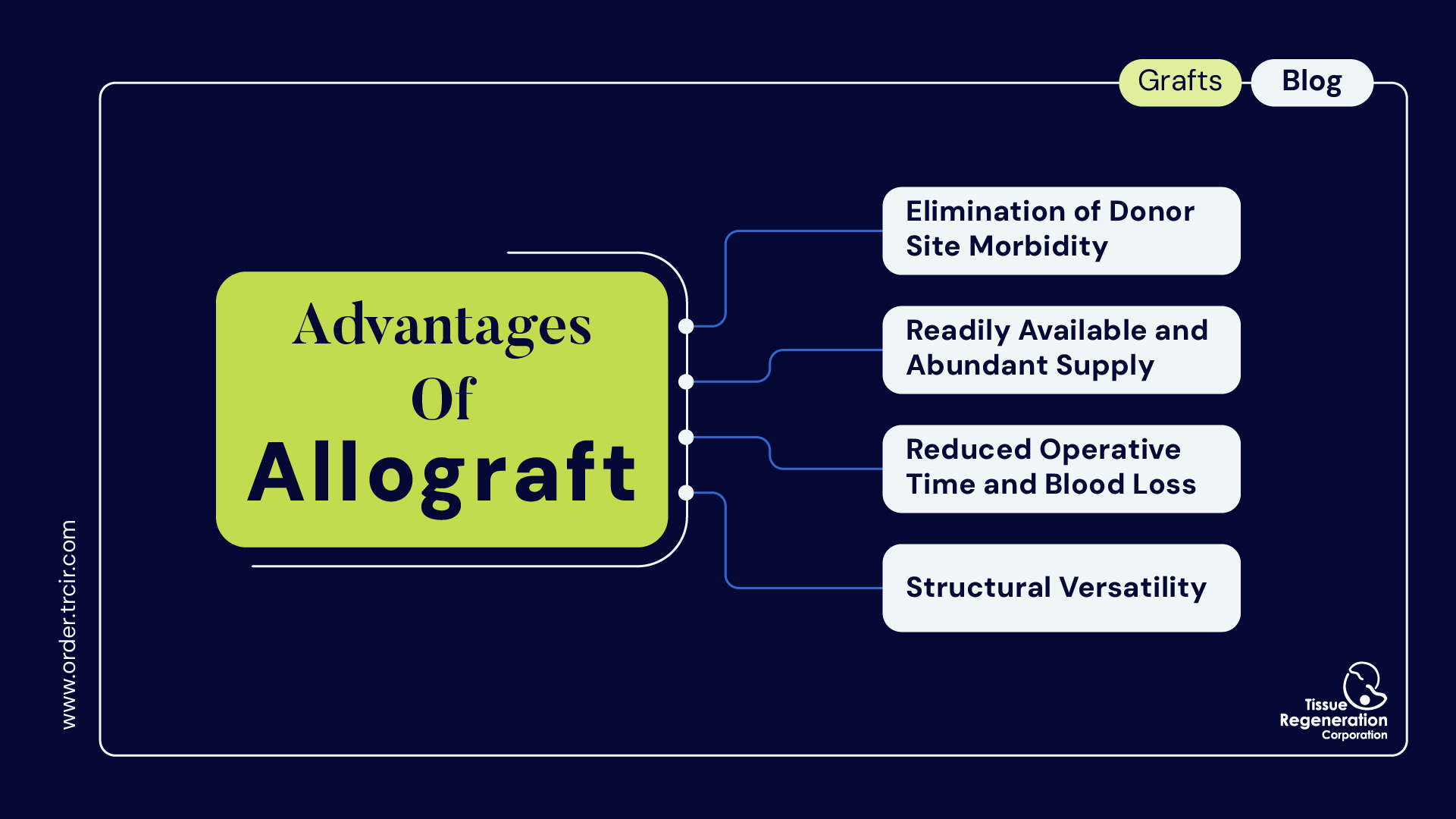
- Elimination of Donor Site Morbidity: This is the most compelling benefit. There is no second surgical site, meaning the patient is spared the associated pain, potential complications, and recovery time of a harvest procedure.
- Readily Available and Abundant Supply: Allografts are available “off-the-shelf” in large quantities and a vast array of shapes and sizes. This allows surgeons to select the precise structural or particulate graft needed for any given defect, no matter how large.
- Reduced Operative Time and Blood Loss: By eliminating the need for a harvest procedure, allografts significantly shorten the overall surgery time and reduce associated blood loss, contributing to a safer procedure for the patient.
- Structural Versatility: Allografts can be sourced as large cortical segments or even entire osteoarticular blocks, providing structural support for major reconstructions (e.g., limb salvage, joint revisions) that would be impossible with autograft.
Potential Risks and Disadvantages of Allograft
While modern processing has made allografts remarkably safe and effective, they are not without their own set of considerations.
- Risk of Disease Transmission: Although modern screening and sterilization have made this risk exceedingly low (estimated to be less than one in a million), it is not zero and remains a theoretical concern.
- Potential for Immunogenic Response: Processing removes most cellular material, but a low-level immune response from the host is still possible, which can interfere with graft incorporation.
- Slower Incorporation Rate: Allografts are primarily osteoconductive. While some processed forms retain osteoinductive potential, they lack the living osteogenic cells of an autograft. This typically results in a slower rate of incorporation and fusion compared to the “gold standard.”
- Cost: The cost of the allograft material itself can be higher than the procedural cost of harvesting an autograft, which may be a factor in some healthcare systems.
Head-to-Head Comparison: Allograft vs. Autograft in Clinical Practice
To facilitate a clear choice, the key characteristics of each graft type are summarized below.
| Feature | Autograft | Allograft |
| Source | Patient’s own body (e.g., iliac crest) | Screened human donor |
| Biological Properties | Osteogenic, Osteoinductive, Osteoconductive | Primarily Osteoconductive; some forms are weakly Osteoinductive |
| Immunogenicity | None (fully compatible) | Low to minimal (most cellular material removed) |
| Disease Transmission Risk | Zero | Extremely low (< 1 in 1,000,000) |
| Donor Site Morbidity | High (pain, infection, nerve damage) | None |
| Availability | Limited by patient’s supply and quality | Abundant, available in various shapes and sizes |
| Operative Time | Increased due to harvest procedure | Reduced |
| Cost | Procedural cost of harvesting | Material cost of the graft product |
| Incorporation Rate | Faster and more reliable | Slower |
| Structural Integrity | Good, but limited by harvestable size | Excellent; available as large cortical struts and segments |
Key Factors in Surgical Graft Selection: A Decision-Making Framework
The optimal surgical graft selection is never a one-size-fits-all decision. It is a nuanced choice based on a careful evaluation of the patient, the defect, and the goals of the procedure.
- The Patient’s Profile
- Age and Comorbidities: In a young, healthy patient, the robust healing potential might favor an autograft if the defect is small. In an elderly patient with significant comorbidities (e.g., cardiovascular disease, diabetes), the shorter operative time and avoidance of a second surgical site make an allograft a much safer and more appealing option.
- Bone Quality: For patients with osteoporosis, the quality of their own bone may be poor, making a dense, structurally sound allograft a superior choice.
- The Nature of the Defect
- Size and Location: For small, contained defects where high osteogenic potential is critical (e.g., non-union of a small bone), an autograft is often preferred. For large segmental defects requiring significant structural support (e.g., following tumor resection), a cortical allograft strut is often the only viable option.
- Mechanical Demands: In high-stress environments like an anterior cervical discectomy and fusion (ACDF), the rapid and reliable fusion provided by an autograft is highly desirable.
- The Specific Surgical Procedure
- Spinal Fusion: In multi-level spinal fusions, the volume of graft required often exceeds the available autograft supply, making allograft (often supplemented with other biologics) a necessity.
- Dental and Maxillofacial Surgery: For procedures like sinus lifts and socket preservation, allograft powders and particulates are standard practice. They eliminate morbidity and provide sufficient scaffolding for new bone growth in a non-load-bearing environment.
- Joint Revision Surgery: In revision arthroplasty, large structural allografts are invaluable for restoring bone stock that has been lost around a failed implant.
Conclusion: Synthesizing the Evidence for Optimal Outcomes
The allograft vs. autograft debate is not about declaring one universally superior to the other. Rather, it is about understanding their distinct profiles to make the best clinical decision for each unique patient and scenario. The autograft remains the biological “gold standard,” offering the most powerful combination of osteogenic, osteoinductive, and osteoconductive properties. However, its significant donor site morbidity and limited supply are undeniable drawbacks.
The allograft, backed by decades of advancement in tissue banking and processing, has emerged as a safe, effective, and incredibly versatile alternative. It eliminates patient morbidity, offers unlimited supply, and provides structural solutions unattainable with autograft. While its biological activity is primarily osteoconductive, its role as a reliable and readily available scaffold has made it an indispensable tool in the surgeon’s arsenal.
The future of bone grafting likely lies in combination therapies—using allograft scaffolds as carriers for powerful biologics like BMPs or cellular bone matrices, thereby creating a graft that has the convenience of an allograft with the biological power of an autograft. Until then, the surgeon’s expertise lies in carefully weighing the evidence, the patient’s health, and the surgical demands to select the graft that promises the safest and most effective path to healing.
Frequently Asked Questions (FAQ)
- Is an allograft as strong as an autograft? Biomechanically, a structural cortical allograft can be just as strong, if not stronger, than a piece of autograft harvested from the iliac crest. The key difference is in the speed of biological incorporation; the autograft integrates and remodels into living host bone faster.
- What is the real risk of getting a disease from an allograft? The risk is exceptionally low. Due to rigorous donor screening, advanced laboratory testing, and terminal sterilization processes, the statistical risk of viral disease transmission from a modern allograft is estimated to be less than one in a million.
- Does the body reject an allograft? A true rejection is rare. The processing of allografts removes the majority of the cellular material that would trigger a strong immune response. A low-level inflammatory or immune response can occur, which may slightly slow down the healing process, but it is very different from the organ rejection seen in transplant surgery.
- If it has so many drawbacks, why is autograft still called the “gold standard”? It is called the “gold standard” purely from a biological perspective. It is the only option that contains the patient’s own living bone-forming cells (osteogenesis), making its performance the benchmark against which all other graft types are measured in terms of speed and reliability of fusion.
- Are allografts more expensive than autografts? The allograft product itself has a direct cost, whereas the autograft does not. However, a full cost-benefit analysis must include the costs associated with the longer operative time, increased blood loss, potential treatment for donor site complications, and longer hospital stays associated with autograft harvesting. When these factors are considered, the total cost can often be comparable.
- What does lyophilization (freeze-drying) do to an allograft? Lyophilization is a dehydration process that removes water from the tissue. This stops biological degradation, allows the graft to be stored safely at room temperature for years, and helps reduce its immunogenicity. Before implantation, the freeze-dried graft is rehydrated with saline or the patient’s own blood.
References
1- General Comparison and Overview of Graft Types
2- Donor Site Morbidity of Autografts (Iliac Crest)
3- Biological Principles of Bone Healing
4- Allograft Processing and Safety
5- Clinical Applications and Comparison in Spinal Surgery
6- Modern Overview of Bone Graft Substitutes