

Introduction
Spinal fusion surgery is a cornerstone in the management of various spinal pathologies, including degenerative disc disease, spinal instability, deformities, and trauma [1]. The ultimate objective is to achieve a solid bony bridge between two or more vertebrae, thereby stabilizing the spinal segment, alleviating pain, and preventing further neurological deterioration.
While autologous bone graft (autograft) has historically been considered the “gold standard” due to its inherent osteogenic, osteoinductive, and osteoconductive properties, its use is associated with donor site morbidity, increased operative time, and limited supply [2]. Consequently, allografts for spinal fusion, derived from cadaveric human bone, have gained widespread acceptance as an alternative.
Allografts offer the advantages of unlimited supply, elimination of a second surgical site, reduced operative time, and decreased post-operative pain [3]. However, the diverse array of allograft products, each with unique biological and biomechanical characteristics, necessitates a nuanced understanding to optimize patient outcomes. This article, from a neurosurgeon’s perspective, elucidates the critical considerations in selecting the appropriate allograft for spinal fusion, emphasizing biological properties, clinical applications, and adjunctive biologics.
Biological Properties of Bone Grafts
To effectively choose an allograft, it is essential to understand the fundamental biological mechanisms by which bone grafts promote fusion:
- Osteoconduction: This refers to the ability of the graft material to provide a scaffold or matrix upon which host osteoprogenitor cells can migrate, attach, and differentiate into osteoblasts, ultimately forming new bone. The porous structure of bone allografts facilitates revascularization and cellular ingrowth [4].
- Osteoinduction: This is the capacity of certain graft materials to induce undifferentiated mesenchymal stem cells (MSCs) from the host to differentiate into osteoblasts. This process is primarily mediated by growth factors embedded within the bone matrix, most notably bone morphogenetic proteins (BMPs) [5].
- Osteogenicity: This property denotes the presence of viable osteoblasts within the graft that can directly form new bone. Autografts possess all three properties (osteoinductive, osteoconductive, and osteogenic) to varying degrees. Allografts, due to processing (e.g., freezing, freeze-drying, demineralization), generally lack viable cells and thus are not osteogenic [2].
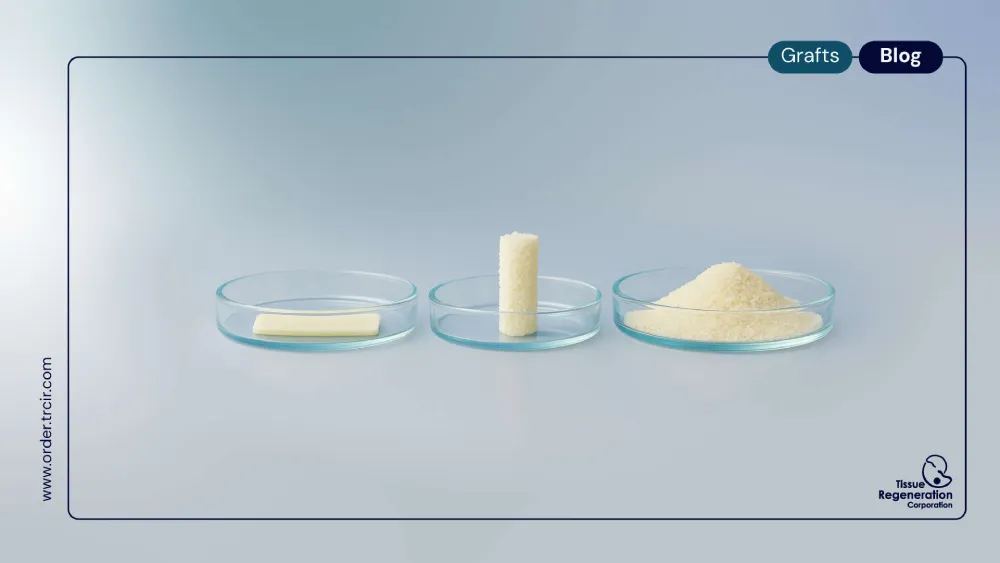
Types of Allografts for Spinal Fusion and Their Characteristics
Allografts are processed differently, impacting their biological and mechanical profiles. Understanding these types is key to selecting the best bone graft substitute.
1. Cortical Allografts
(Such as different bone shafts, rings, struts, and so on)
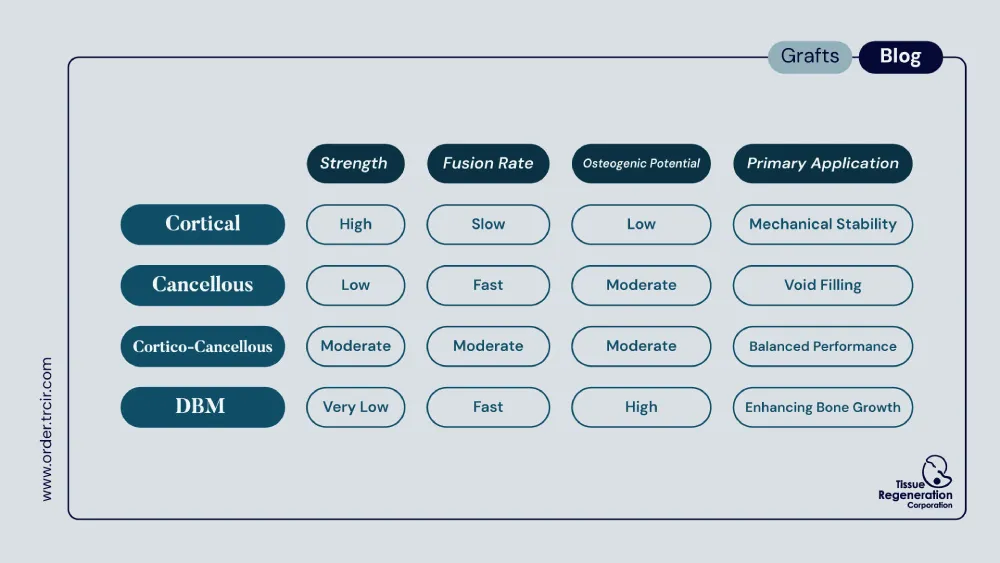
- Characteristics: Derived from the dense outer layer of bone (e.g., femur, tibia). They are primarily structural, offering high mechanical strength and rigidity.
- Processing: Typically freeze-dried (dehydrated) to minimize antigenicity and allow for room temperature storage. Although some forms remain fresh after being processed and delivered to the surgeon fresh frozen.
- Applications: Commonly used as structural spacers (e.g., dowels, rings, cages) in interbody fusion procedures (e.g., ALIF, TLIF, PLIF) to maintain disc space height and provide immediate mechanical stability [6]. They are osteoconductive but possess minimal osteoinductive potential.
- Limitations: Slower incorporation rates due to dense structure.
2. Cancellous Allografts
(Such as cubes, blocks, matchsticks, and so on)
- Characteristics: Obtained from the spongy inner bone (e.g., ilium, epiphyseal parts of the bones, vertebral bodies). Characterized by a highly porous, trabecular structure.
- Processing: Often freeze-dried.
- Applications: Excellent osteoconductive scaffolds. Their large surface area and interconnected pores facilitate rapid cellular infiltration, vascularization, and new bone formation. They are typically used to fill voids and augment fusion beds [7].
- Limitations: Low mechanical strength, hence unsuitable for primary structural support. Limited osteoinductive potential.
3. Cortico-Cancellous Allografts
(Such as strips, wedges, chips, and so on)
- Characteristics: A blend of cortical and cancellous bone, offering a balance of structural support and osteoconductive properties.
- Applications: Provide both initial stability and a scaffold for bone growth. Often available as chips or blocks.
- Limitations: The osteoinductive capacity is still limited.
4. Demineralized Bone Matrix (DBM)
- Characteristics: Produced by acid extraction of the mineral phase from allograft bone, exposing the inherent growth factors, predominantly BMPs, within the bone matrix. This process significantly enhances osteoinductivity [8].
- Processing: Available in various forms including gel, putty, or chips. The carrier material (e.g., glycerol, hyaluronic acid) can influence handling characteristics.
- Applications: Used as an osteoinductive adjunct to enhance fusion rates, particularly in challenging spinal fusion environments, pseudarthrosis repairs, or in combination with osteoconductive scaffolds.
- Limitations: Lacks structural integrity and cannot provide mechanical support. The osteoinductive potential can vary significantly between DBM products due to variations in processing and carriers [9].
Clinical Considerations for Allograft Selection
Neurosurgeons must weigh several factors when choosing an allograft for spinal fusion:
1. Patient-Specific Factors
- Age and Bone Quality: Younger patients may fuse readily with less potent allografts. Older patients, those with osteoporosis, or compromised healing (e.g., smokers, diabetics) may necessitate allografts with higher osteoinductive properties or adjunctive biologics [10].
- Comorbidities: Systemic diseases or medications impacting bone metabolism (e.g., steroids) can impair fusion.
- Spinal Pathology: The underlying condition (e.g., degenerative disc disease, tumor, deformity) influences the demands on the graft.
2. Surgical Factors
- Fusion Location and Extent: Single-level fusions have different requirements than multi-level, instrumented fusions. Anterior approaches (e.g., ALIF) often utilize larger structural allografts, while posterior approaches (e.g., PLIF/TLIF) may combine structural grafts with DBM.
- Need for Immediate Stability: If primary structural support is paramount, cortical allografts are preferred.
- Gap Filling vs. Load Bearing: Cancellous allografts or DBM are excellent for filling gaps, whereas cortical grafts are essential for load-bearing.
- Presence of Instrumentation: Rigid internal fixation (screws, rods) provides immediate stability, allowing for a broader choice of allografts that may be less mechanically robust but more biologically active [11].
The Evolving Role of Adjunctive Biologics in Spinal Fusion
While allografts provide osteoconductive scaffolds (and DBM provides osteoinduction), integrating advanced biologics can further enhance fusion rates in challenging cases.
- Recombinant Human Bone Morphogenetic Proteins (rhBMPs): rhBMP-2 and rhBMP-7 are powerful osteoinductive agents. However, their use is associated with potential complications (e.g., swelling, heterotopic ossification), necessitating careful patient selection [12, 13].
- Cell-Based Therapies:
- Autologous Bone Marrow Aspirate Concentrate (BMAC): Rich in MSCs, BMAC can be combined with allografts to enhance osteogenic and osteoinductive potential [14].
- Mesenchymal Stem Cell (MSC) Allografts: Off-the-shelf MSC products are being investigated for their osteoinductive properties.
- Platelet-Rich Plasma (PRP): While containing growth factors, the evidence for PRP’s efficacy in enhancing spinal fusion is mixed and less robust than for BMPs or BMAC [15].
Conclusion: Optimizing Allograft Selection in Spinal Fusion
The selection of the optimal allograft for spinal fusion is a critical decision in modern neurosurgical practice. It requires a comprehensive understanding of the allograft’s biological properties (osteoconductivity, osteoinductivity), mechanical characteristics, patient factors, and surgical demands.
While autograft remains the benchmark, the judicious use of allografts—often augmented with advanced biologics like DBM, rhBMPs, or BMAC—allows neurosurgeons to tailor treatment, minimize donor site morbidity, and achieve favorable fusion outcomes. Continued research will further refine our ability to promote robust spinal fusion.
🔗 Reference Links
[1] (Book Link) https://shop.lww.com/Bridwell-and-DeWald-s-Textbook-of-Spinal-Surgery/p/9781975142145 [2] (Article seems to be from ‘Journal of Spinal Disorders’, 1996) https://pubmed.ncbi.nlm.nih.gov/8919429/ (Note: Your citation date [2000] might be slightly different, but this is a highly relevant paper by the same authors on the topic). [3] https://pubmed.ncbi.nlm.nih.gov/7831011/ [4] https://pubmed.ncbi.nlm.nih.gov/8040277/ [5] https://pubmed.ncbi.nlm.nih.gov/4333701/ [6] (General reference for Seminars in Spine Surgery) https://www.sciencedirect.com/journal/seminars-in-spine-surgery [7] https://pubmed.ncbi.nlm.nih.gov/16306899/ [8] https://pubmed.ncbi.nlm.nih.gov/5342452/ [9] https://pubmed.ncbi.nlm.nih.gov/21803507/ [10] https://pubmed.ncbi.nlm.nih.gov/16227914/ [11] https://www.semss.org/article/S1040-7383(05)00035-7/fulltext [12] https://pubmed.ncbi.nlm.nih.gov/21497604/ [13] https://pubmed.ncbi.nlm.nih.gov/19947627/ [14] https://pubmed.ncbi.nlm.nih.gov/1842787/ [15] https://pubmed.ncbi.nlm.nih.gov/17468744/