


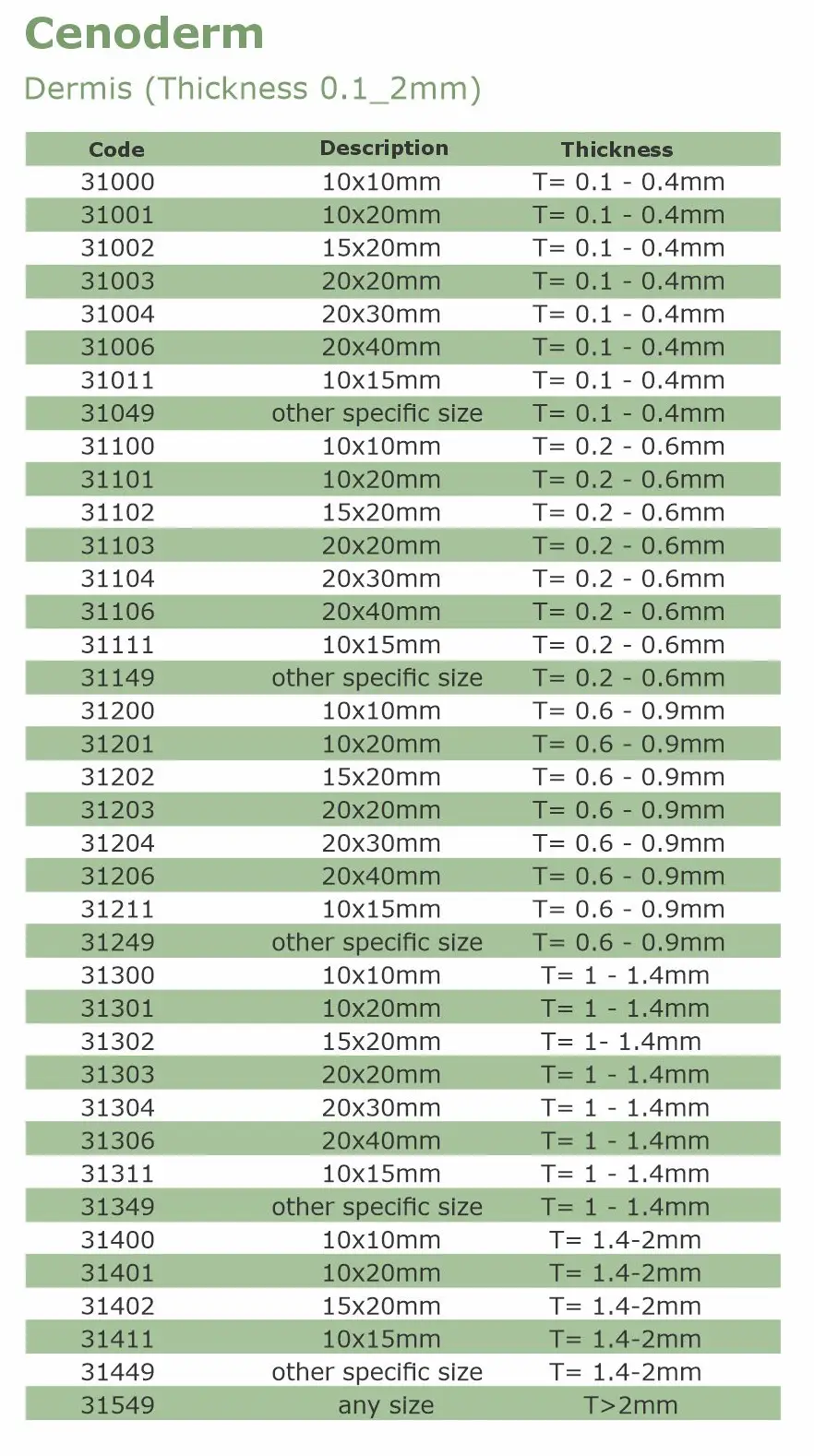
Cenoderm is an allograft derived from human skin (dermis), designed as an effective alternative to autogenous connective tissue grafts. It serves as a biological barrier in GTR (Guided Tissue Regeneration) procedures. Compared to standard membranes, Cenoderm exhibits a longer resorption time and, in thicker variations, allows for open healing (exposure).
Structural Mechanism & Orientation: Cenoderm features a dual-surface structure, each with distinct collagen compositions:
Smooth Surface: Contains Type I and V collagen. This side should face outward (towards the soft tissue/oral cavity) to enhance cell guidance and barrier function.
Porous Surface: Contains Type II and IV collagen. This side must be placed facing the bone graft or powder to promote revascularization and blood supply.
Thickness Classifications & Resorption: Cenoderm is available in three categories based on thickness and exposure capability:
Thin (0.2 – 0.6 mm): Non-exposable. Max resorption time: 2 months.
Medium (0.6 – 0.9 mm): Up to 10-15% exposure allowed. Max resorption time: 4 months.
Thick (> 1.0 mm): Suitable for exposed placement (e.g., FGG substitute). Resorption time: > 6 months.
Surgical Notes:
Fixation: When used in an exposed manner, the matrix must be securely fixed with sutures.
Vascularization: It is mandatory to tuck the membrane at least 2 mm under the gingival flap on all sides to ensure adequate blood supply.
Indications:
Treatment of periodontal and gingival diseases.
Implant dentistry and maxillofacial surgery.
Sinus lift procedures (protection of the Schneiderian membrane).
Socket preservation (post-extraction).
Alveolar ridge preservation and reconstruction.
Vertical and horizontal bone augmentation.
Treatment of 1 to 3-wall intrabony defects.
Substitute for Free Gingival Grafts (FGG) and GTR.