
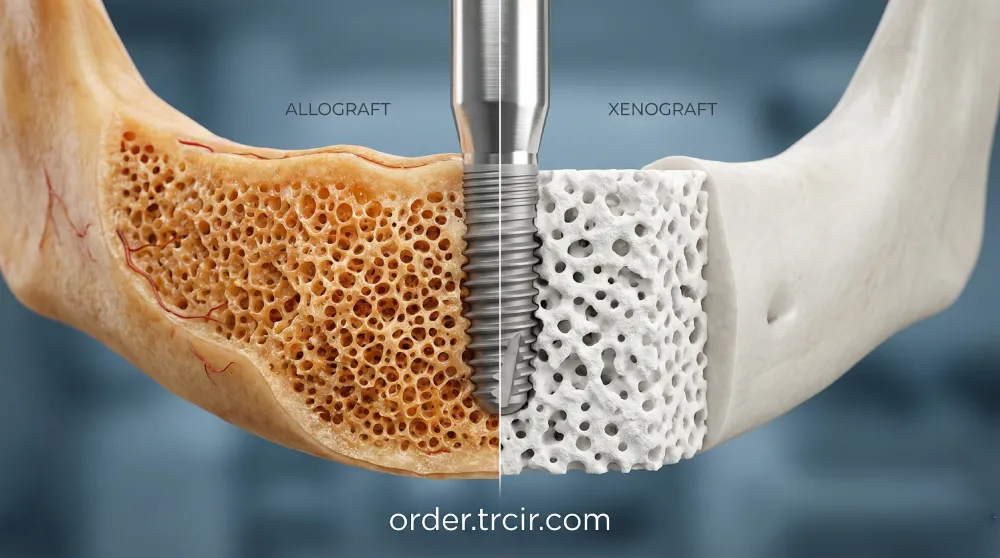
The defining challenge of modern implant dentistry and periodontology is not just replacing what’s lost, but rebuilding it. When a patient presents with a deficient ridge, a compromised extraction socket, or requires a sinus lift, the success of the entire treatment plan rests on our ability to regenerate viable, stable bone. This is the cornerstone of guided bone regeneration (GBR).
To build this new bone, we need a scaffold. While the patient’s own bone (autograft) is often called the “gold standard,” its use requires a second surgical site, increasing morbidity and surgical time. This has led to the dominance of “off-the-shelf” grafting materials.
For decades, the primary clinical debate has centered on the two most popular and effective options: allograft vs xenograft.
This is not a simple question of preference. The choice between an allograft and a xenograft has profound implications for healing time, biological response, and the long-term architectural stability of the augmented site. At trcir.com, we believe that an empowered clinician is one who understands the precise mechanisms of these materials. This guide provides a detailed clinical comparison of allograft vs xenograft to help you select the ideal material for every unique surgical scenario.
The Four Pillars of Bone Grafting: A Quick Review
Before we compare allograft vs xenograft, it’s crucial to position them within the complete landscape of bone grafting options. All grafts fall into one of four categories.
- Autograft: Bone harvested from the patient’s own body (e.g., the ramus, chin, or iliac crest). It is osteoconductive, osteoinductive, and osteogenic (it has living cells).
- Allograft: Bone sourced from another human being (a deceased, screened donor). This is the category that includes Human Tissue Allografts.
- Xenograft: Bone derived from an animal source (typically bovine or porcine) that is processed to remove all organic matter.
- Alloplast: A synthetic, lab-created material (e.g., hydroxyapatite, beta-tricalcium phosphate).
The allograft vs xenograft debate is the most relevant one for daily practice because they are the most widely used grafts for their safety, availability, and extensive clinical documentation.
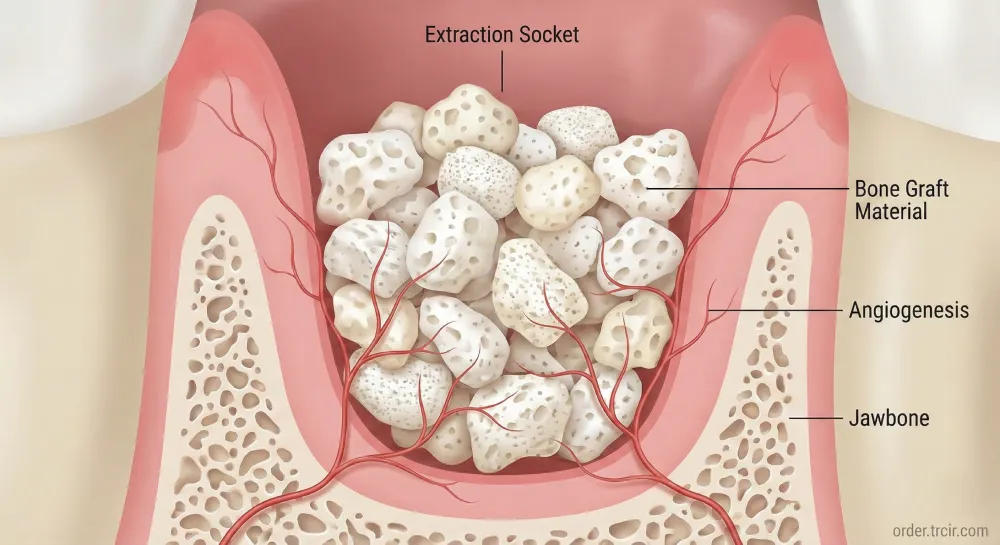
A Deep Dive into Allograft (Human Tissue Allografts)
An allograft is a bone graft processed from a human donor. These donors are subjected to an exhaustive screening process, rivaling that of organ donation, to rule out any transmissible diseases. The tissue is then processed and terminally sterilized to ensure it is safe and non-immunogenic.
The quality of this processing is paramount this is why standards such as FDA clearance are essential. Using FDA-approved human tissue products means relying on materials that have been independently evaluated for safety, sterility, and quality management, ensuring a consistently high level of clinical reliability.
Allografts are most commonly available in two primary forms:
Freeze-Dried Bone Allograft (FDBA)
This is an allograft where the bone is processed to remove water and cells, but the mineral structure and some collagen are preserved.
- Mechanism: FDBA is primarily osteoconductive. It provides a natural, human-based scaffold for the patient’s own bone-forming cells (osteoblasts) and blood vessels to grow into.
- Resorption: It has a predictable resorption profile. It is gradually broken down by osteoclasts and replaced by the patient’s own new bone over a period of 4-6 months.
Demineralized Freeze-Dried Bone Allograft (DFDBA)
This is FDBA that has undergone an additional step: acid demineralization. This process removes much of the inorganic mineral component, exposing the underlying collagen matrix.
- Mechanism: DFDBA is both osteoconductive (from its collagen scaffold) and osteoinductive. The demineralization process exposes the natural growth factors (like bone morphogenetic proteins, or BMPs) trapped within the bone matrix. These proteins actively signal the patient’s undifferentiated cells to become bone-forming cells.
- Resorption: It resorbs more quickly than FDBA as it is less a mineral scaffold and more a biological “signal.”
Pros of Allograft:
- Excellent Biocompatibility: It is a human-to-human graft, providing a highly familiar scaffold.
- True Regeneration: It is designed to be fully resorbed and replaced by 100% new, vital host bone.
- Osteoinductive Potential: DFDBA offers biological signaling that can accelerate bone formation.
- Handling: Available in various particulate sizes, putty, and as blocks.
Cons of Allograft:
- Faster Resorption: This can be a con if space maintenance is the only goal. If a membrane is compromised, the allograft may resorb too quickly.
- Patient Perception: A small subset of patients may be hesitant about a human donor source, though this is rare with proper education.
A Deep Dive into Xenograft
A xenograft is a bone graft derived from an animal source. The vast majority of xenografts used in dentistry are bovine (cow) or porcine (pig) in origin.
The processing of a xenograft is fundamentally different from that of an allograft. The goal is to remove all organic components (cells, proteins, fat) to prevent any possible immune response or disease transmission. This is typically done through a high-temperature (sintering) or chemical process.
The result is a purely anorganic scaffold—it is the mineral component of bone (hydroxyapatite) in its natural, porous architecture.
- Mechanism: Xenograft is purely osteoconductive. It is a passive, non-resorbing scaffold. It does not send any biological signals. Its sole job is to hold the space and act as a durable framework for new bone to grow onto and into.
- Resorption: This is the most defining characteristic of a xenograft. It resorbs extremely slowly, if at all. Many studies show xenograft particles still present in biopsy cores 5, 10, or even 20 years post-placement. The particles do not get “replaced”; they become integrated into the new bone, with host bone fusing directly to the particle surface (osseointegration).
Pros of Xenograft:
- Superior Space Maintenance: Its non-resorbing nature makes it the undisputed champion for holding volume, especially in large augmentations.
- Long-Term Data: It has been used for decades with an incredible track record of success in Clinical Applications like sinus lifts.
- Unlimited Supply: Sourcing is easy and not dependent on human donors.
- Patient Acceptance: Many patients are more comfortable with this (processed mineral) source than a human source.
Cons of Xenograft:
- Incomplete Remodeling: The augmented site will never be 100% vital, host bone. It will be a “composite” of host bone and graft particles.
- No Biological Activity: It is purely passive, which may mean slower bone formation compared to DFDBA.
- Cultural/Religious Objections: The use of bovine or porcine materials can be a contraindication for some patients.
Allograft vs Xenograft: A Head-to-Head Comparison
The allograft vs xenograft debate is best summarized by comparing their core properties and how those properties serve different clinical goals.
| Feature | Allograft (Human Tissue Allografts) | Xenograft (Bovine/Porcine) |
| Source | Human Donor | Animal Source (Mineral) |
| Biological Activity | Osteoconductive (FDBA)
Osteoinductive (DFDBA) | Strictly Osteoconductive |
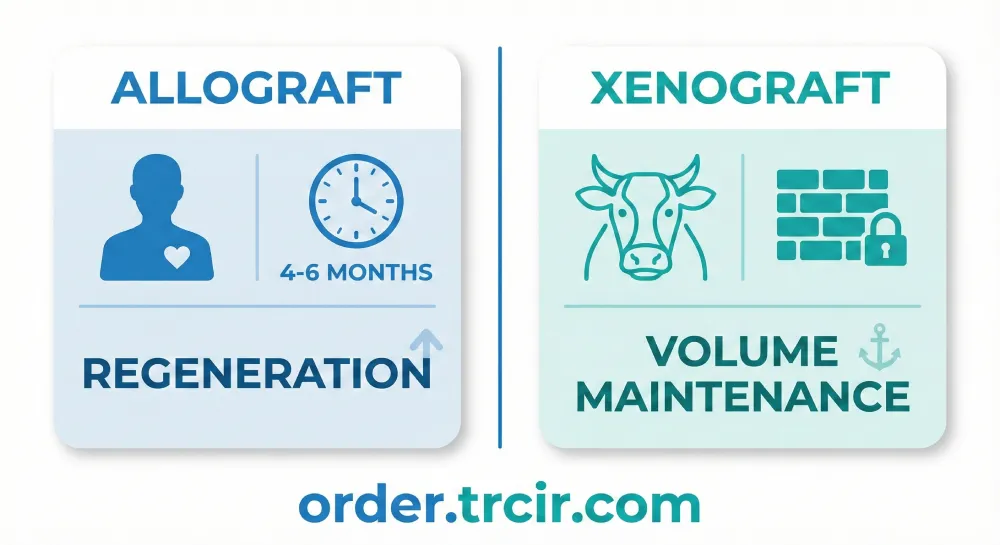
| Primary Goal | Regeneration: To be replaced by new host bone. | Stability: To act as a permanent scaffold for new bone. |
| Resorption Rate | Predictable (4-12 months): Designed to be fully resorbed and remodeled. | Extremely Slow (Years): Designed to be integrated, not replaced. |
| Space Maintenance | Good, but dependent on membrane integrity. | Excellent. This is its primary advantage. |
| Resulting Tissue | 100% vital host bone (in time). | A composite of vital host bone and integrated graft particles. |
Clinical Applications: When Should I Choose Allograft vs Xenograft?
The right choice is always the one that matches the material’s properties to the specific surgical objective.
When to Choose Allograft:
Allograft is the choice when your goal is true regeneration—you want the end result to be 100% native, patient-owned bone.
- 1. Socket Preservation: This is a classic application. A resorbing allograft (FDBA or a mix) perfectly preserves the ridge volume for 4-6 months, and by the time you re-enter for the implant, the socket is filled with new, vital bone that is easy to drill.
- 2. Periodontal Defects: In treating infrabony defects, DFDBA is often preferred for its osteoinductive “kick” to promote regeneration in a challenging environment.
- 3. GBR with Full Remodeling: When performing guided bone regeneration on a contained defect, an allograft ensures that the final augmented bone is of the highest biological quality for implant integration.
- Sinus Augmentation (Sinus Lift) Allograft is an excellent option in sinus augmentation when the clinician aims for predictable remodeling and long-term native bone formation. In this procedure, space maintenance is still important, but unlike xenograft, the goal is to achieve full biological integration and replacement with vital bone. Allograft provides a naturally osteoconductive scaffold that remodels into patient’s own bone, improving future implant stability and long-term tissue health.
- 5.Large Lateral Ridge Augmentation In horizontal ridge augmentation, allograft is beneficial when the clinician needs substantial bone regeneration with faster incorporation compared to xenograft. Allograft remodels more physiologically, allowing the regenerated ridge to behave more like native bone. When used with membranes or tenting screws, it provides adequate volume stability while ultimately converting into host bone for strong, more natural implant support.
- Treating Dehiscence / Fenestration Defects Allograft is highly suitable for buccal dehiscence and fenestration repair during implant placement because it integrates rapidly, promotes predictable defect fill, and supports the formation of vital bone around the implant surface. Its osteoconductive and, in some preparations, osteoinductive properties help accelerate defect healing, reducing the risk of early implant exposure and improving long-term outcomes.
When to Choose Xenograft:
Xenograft is the choice when your goal is maximum stability and long-term volume preservation.
- In many of these procedures, a xenograft can also be used. The choice between allograft, xenograft, or a combination of both depends on the patient’s age, the required graft volume, and the specific clinical conditions. Allograft is often preferred when faster remodeling and the formation of vital bone are desired, while xenograft may be selected—alone or in combination—when additional long-term volume stability is needed.
The “Hybrid” Approach: The Best of Both Worlds
Many advanced clinicians have moved past the allograft vs xenograft dichotomy and now use them together. By mixing an allograft with a xenograft (e.g., a 50/50 mix), you get:
- The biological “boost” and remodeling potential of the allograft.
- The long-term structural stability and space maintenance of the xenograft.
This hybrid approach is extremely effective for large GBR cases where both biology and architecture are critical.
The order.trcir.com Perspective: Choice is Power
The allograft vs xenograft debate isn’t about finding a single winner. It’s about understanding your tools. There is no single “best” graft, only the “best” graft for a specific one of your Clinical Applications.
A clinician who only uses xenograft may find their socket grafts are difficult to drill. A clinician who only uses allograft may be frustrated by the lack of long-term volume in a large ridge augmentation.
At trcir.com, our philosophy is to empower you with choice. We provide access to the highest quality, FDA approval in human tissue products
for when your goal is true regeneration. We also provide premium xenograft materials for when your goal is structural integrity. By understanding the profound differences in their mechanisms and resorption rates, you can elevate your surgical outcomes and provide a truly customized, predictable, and successful treatment for every patient.
Frequently Asked Questions (FAQ)
So, which is better in the allograft vs xenograft debate?
Neither is “better.” They are different tools for different jobs. Allograft is better for regeneration (being replaced by new bone). Xenograft is better for stability (acting as a permanent scaffold). The best clinicians stock both and choose based on the surgical goal.
How long do I have to wait before placing an implant in these grafts?
The healing time is often similar (typically 4-9 months), but for different reasons. An allograft site is healing as the graft is replaced. A xenograft site is healing as the new bone integrates with the graft particles. The timeline is determined by the size of the defect and the patient’s healing, not just the material.
Is there a risk of disease from Human Tissue Allografts?
This is a common patient concern, but with modern processing, the risk is virtually zero. FDA approval in human tissue products
like those offered by trcir.com, are sourced from meticulously screened donors and undergo terminal sterilization (e.g., gamma irradiation) that inactivates all viruses, bacteria, and prions. The safety record of these products is outstanding.
Will my body reject a xenograft?
Rejection (an immune response) is not a concern because all organic, immunogenic components are removed during processing. The final xenograft material is just a bone mineral. It is highly biocompatible, and the body does not recognize it as “foreign.”
Can I mix an allograft and a xenograft?
Absolutely. This is a very popular and advanced technique. By mixing them, you create a “hybrid” graft that combines the biological advantages of an allograft (osteoinduction from DFDBA) with the structural, space-maintaining advantages of a xenograft.
Scientific Sources
- Systematic Review on Allograft vs. Xenograft in Sinus Lifting:
- Corbella, S., Taschieri, S., & Del Fabbro, M. (2018). Long-term outcomes for the management of the edentulous posterior maxilla: a systematic review of allograft vs. xenograft. International Journal of Implant Dentistry, 4(1).
- Link: https://wwwimplantdent.springeropen.com/articles/10.1186/s40729-018-0118-z
- Histologic Comparison of Grafting Materials in Ridge Preservation:
- Cardaropoli, G., & Cardaropoli, D. (2007). Preservation of the postextraction ridge: a clinical and histologic study. The International Journal of Periodontics & Restorative Dentistry, 27(5), 469–477.
- Link: https://pubmed.ncbi.nlm.nih.gov/17992646/ (This study compares various materials and provides a good histological basis for the “composite” vs. “replacement” healing.)
- Review of Bone Grafting Materials in Dentistry:
- El-Bialy, T., & El-Bialy, A. (2015). Bone regeneration in dentistry: A review of the literature. The Journal of Contemporary Dental Practice, 16(5), 414-421.
- Link: https://www.jaypeejournals.com/ecom/html/jp/JCDP/JCDP_2015_05_16_5_414_421.pdf
- Long-Term Fate of Bovine Xenografts:
- Miron, R. J., Sculean, A., & Buser, D. (2020). The long-term fate of xenogeneic bone-grafting materials: a review of the literature and a case report. Quintessence International, 51(8), 664-673.