
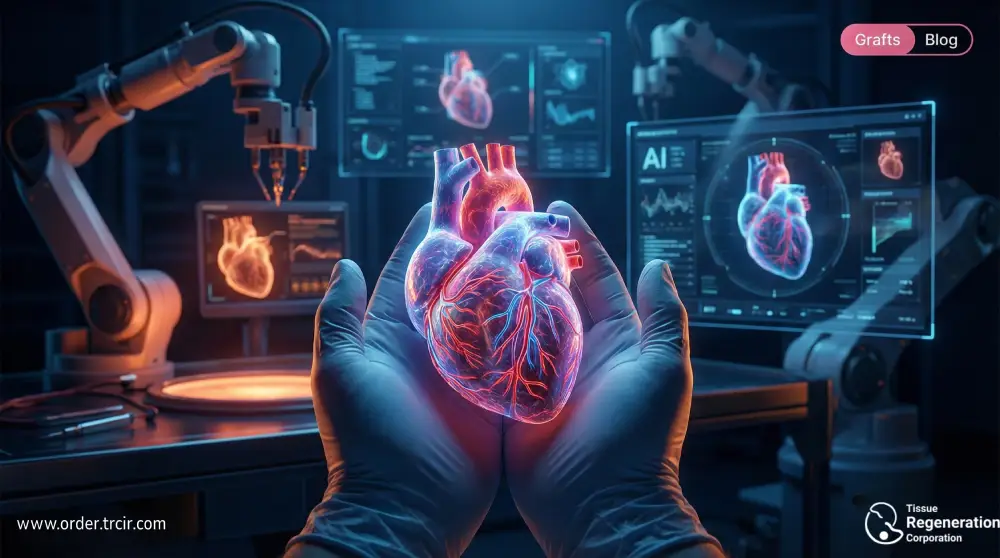
For decades, the promise of regenerative medicine has been simple, yet profound: to move beyond treating symptoms and begin to truly heal and replace damaged human tissue. Today, we stand at an inflection point. The convergence of artificial intelligence, materials science, and cellular biology is transforming tissue engineering from a futuristic concept into a clinical reality.
The future of tissue engineering is no longer about just seeding cells onto a simple scaffold. It’s about creating dynamic, intelligent, and personalized living constructs that integrate seamlessly with the human body. As a company dedicated to human tissue regeneration, understanding this new frontier is not just an academic exercise—it is central to our mission.
As we look toward 2027, the field is accelerating at an unprecedented rate. The question is no longer if we can engineer complex tissues, but how we will do so safely, effectively, and at scale. This article explores the five most significant innovations and trends poised to redefine regenerative medicine in the coming years.
- 3D Bioprinting: From Simple Constructs to Vascularized Tissues
3D bioprinting—the layer-by-layer deposition of “bio-inks” containing living cells—has long captured the public imagination. For years, the primary challenge has been “printing” hollow tubes, resulting in simple tissues like cartilage or skin. The true barrier to creating complex organs like a kidney or liver has always been vascularization.
A dense, 3D-printed tissue construct is useless if cells in the center cannot get oxygen and nutrients. By 2027, this challenge is set to be overcome through several key tissue engineering innovations.
- Advanced Bio-inks and Sacrificial Gels: We are seeing the rise of sophisticated bio-inks that not only support cell life but actively guide tissue formation. More importantly, new techniques involve printing “sacrificial” materials. A network of channels is printed using a gel (like Pluronic F-127) that is solid at room temperature but melts and washes away at body temperature. This leaves behind an open, perfusable network of “blood vessels” that can be lined with endothelial cells, effectively creating a living vascular system.
- In Situ (In-Body) Bioprinting: Why build an organ in a lab when you can print it directly where it’s needed? Startups are developing handheld bioprinters for surgeons to “print” skin cells and biomaterials directly onto burn wounds. Recently, researchers have even demonstrated a swallowable, pill-sized bioprinter that can perform internal tissue repair without invasive surgery. By 2027, this concept will expand, allowing for the repair of cartilage in a knee joint or bone in a complex fracture, all in situ.
- Multi-Material and Organoid Printing: The next generation of printers doesn’t just use one cell type. They are “multi-material” systems that can deposit different cell types (e.g., liver cells, vascular cells, and structural cells) and multiple scaffold materials in a single, complex print job. This is being combined with “organoid” technology—tiny, self-assembling “mini-organs” grown from stem cells. Instead of printing individual cells, future bioprinters will deposit these functional organoids as building blocks, dramatically accelerating the creation of a functional organ patch.
Outlook for 2027: While a fully transplantable, 3D-printed kidney is likely still a decade away, we will see the first human clinical trials for complex, vascularized tissue patches to repair damaged hearts, livers, and kidneys.
- The “Smart” Scaffold Revolution
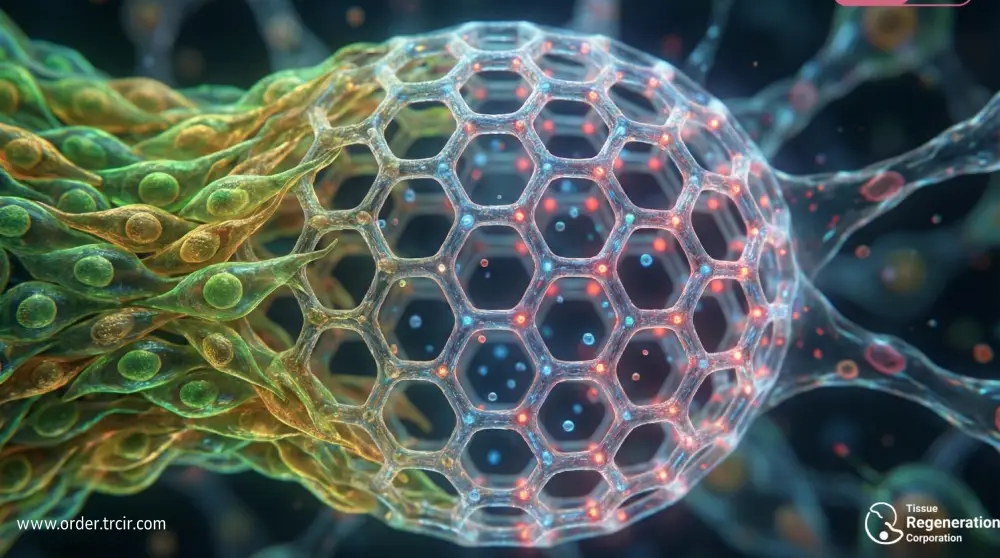
For years, scaffolds were seen as passive supports: a biodegradable “trellis” for cells to climb on. The future of tissue engineering lies in “smart” scaffolds that are active, instructive, and responsive participants in the healing process.
These scaffolds are designed to mimic the native extracellular matrix (ECM) not just structurally, but biochemically and mechanically.
- Bioactive and Gene-Activated Matrices: Smart scaffolds are reservoirs for biological cues. They are loaded with growth factors, proteins, and even nanoparticles containing genetic material (plasmids or mRNA). These “gene-activated” matrices release their payload in a highly controlled, timed manner to instruct cells. For example, a bone scaffold might first release signals to recruit the body’s own stem cells, then release a different factor to tell them to become bone-forming osteoblasts.
- Decellularized Extracellular Matrix (dECM): One of the most promising approaches, central to TRC’s field, is using nature’s own perfect scaffold. This involves taking a donor organ or tissue (e.g., a pig’s heart or human dermis) and gently washing away all the native cells, leaving behind the intricate 3D protein structure of the ECM. This dECM scaffold, which is non-immunogenic, can then be “recellularized” with the patient’s own cells. This provides the ideal micro-environment for cells to grow and organize, turning an allograft into a personalized, regenerative product.
- 4D and Responsive Materials: The “fourth dimension” is time. 4D scaffolds are made from shape-memory polymers or “mechano-responsive” materials. They can be implanted in a compressed state via minimally invasive surgery and then expand into their pre-programmed, complex shape upon reaching body temperature. Other materials are designed to change their properties (e.g., stiffness) in response to biological cues, such as the enzymes released during tissue remodeling, becoming softer as new tissue grows in.
Outlook for 2027: “Off-the-shelf” bioactive dECM and nanofiber scaffolds will become the standard of care for complex wound and orthopedic repairs. We will also see the first human use of 4D-printed scaffolds for cartilage and bone defects.
- AI and “In Silico” Design
Tissue engineering has historically been a slow process of trial and error. A researcher spends months designing a scaffold, seeding it with cells, and waiting to see what happens in a bioreactor. Artificial intelligence is ending this guess-work.
The integration of AI in tissue engineering is arguably the most powerful accelerator in the field. This is the rise of in silico (computer-simulated) regenerative medicine.
- Predictive Modeling: Machine learning algorithms can now be trained on massive datasets from past experiments—data on biomaterial properties, cell signaling pathways, and patient outcomes. An engineer can now ask the AI: “What is the optimal pore size, stiffness, and growth factor combination to grow a functional cardiac patch?” The AI can run thousands of virtual experiments in hours, predicting the most successful designs before a single physical object is built.
- Personalized Construct Design: The future of tissue engineering is personalized. By 2027, a surgeon will be able to take a patient’s CT scan, feed it into an AI model, and have it generate a perfect, patient-specific 3D model for a replacement jawbone or cranial segment. This model will not only match the geometry but also be optimized for cell integration and mechanical load, custom-printed for that one patient.
- Optimizing Bioproduction: AI is also solving the critical challenge of manufacturing. AI-powered sensors in bioreactors can monitor cell health, nutrient levels, and waste products in real-time. The system can then automatically adjust the culture conditions to optimize cell growth and ensure the final tissue product is consistent and meets quality control standards. This is essential for moving from the lab bench to a commercially viable product.
Outlook for 2027: AI-driven design will be a standard, non-negotiable step in the R&D pipeline for all new tissue-engineered products, cutting development time and costs by as much as 50%.
- Advanced Cell Sourcing and CRISPR Editing
The most sophisticated scaffold is useless without the right “seed” a reliable source of functional, living cells. The debate over embryonic stem cells has been largely settled by the dominance of iPSC (induced pluripotent stem cell) tissue engineering.
iPSCs are created by taking a simple cell from a patient, like a skin or blood cell, and “reprogramming” it back to its embryonic-like, pluripotent state. These cells can then be coaxed to become any cell type in the body—neurons, heart cells, liver cells, etc. This is the foundation of personalized medicine.
But the true revolution is combining iPSCs with CRISPR regenerative medicine.
- Creating “Universal” Cell Lines: The biggest problem with using another person’s cells (allogeneic) is immune rejection. CRISPR gene-editing is now being used to create “universal” donor cell lines. By editing specific genes (like the HLA genes) that the immune system uses to recognize foreign cells, scientists can make iPSCs that are effectively “invisible” to the patient’s immune system. This allows for “off-the-shelf” cell therapies without the need for lifelong immunosuppressant drugs.
- Enhancing Cell Function: Why stop at just being invisible? CRISPR can be used to enhance cells. For example, a cartilage-forming chondrocyte could be edited to be more resistant to inflammation, making it a more durable repair for an arthritic joint. Cells could be engineered to “over-produce” specific growth factors to accelerate healing.
- Disease Modeling: Before we implant, we test. iPSCs taken from a patient with a genetic disease (e.g., Parkinson’s) can be grown into “disease-in-a-dish” organoids. This allows researchers to test new drugs and tissue constructs on that patient’s actual diseased tissue in the lab, a perfect platform for personalized drug discovery.
Outlook for 2027: The first clinical trials using CRISPR-edited, hypo-immunogenic iPSCs for conditions like Type 1 Diabetes and Parkinson’s will be underway. The concept of a “universal donor” cell bank will be a commercial reality.
- The Manufacturing and Regulatory Gauntlet
A scientific breakthrough is not an innovation until it reaches a patient. The single greatest barrier to the future of tissue engineering is not science, but logistics: manufacturing and regulation.
Unlike a simple pill, a tissue-engineered product is a living, complex, and delicate “drug.” This creates enormous challenges.
- Scaling from “N=1” to “N=1000”: It is one thing to create a single, perfect tissue construct in a PhD student’s lab. It is another challenge entirely to manufacture thousands of them consistently under strict cGMP (current Good Manufacturing Practice) conditions. The field is rapidly investing in automation, robotics, and closed-loop bioreactor systems to create “bio-factories” that can produce these therapies reliably and cost-effectively.
- The “Vein-to-Vein” Supply Chain: A living cell therapy can have a shelf-life of just hours. This requires a completely new, ultra-cold-chain or “cryo-chain” logistics network. The process—from taking a patient’s cells, shipping them to the bio-factory, manufacturing the product, and shipping the living construct back to the hospital for implantation—is a massive logistical dance.
- Evolving Regulatory Pathways: How does an agency like the FDA or EMA approve a product that is different for every single patient? Regulatory bodies are moving away from the classic drug approval model. They are creating new designations, like the FDA’s RMAT (Regenerative Medicine Advanced Therapy), which allows for more flexible and accelerated approval pathways. They are also focusing on “Real-World Evidence” (RWE), tracking how products perform in patients after approval to confirm their long-term safety and efficacy.
Outlook for 2027: The winners in the regenerative medicine space will be the companies that solve manufacturing and logistics, not just the science. We will see the first RMAT-designated, personalized tissue products achieve full commercial approval, paving the way for a new class of medicine.
Conclusion: The Dawn of True Regeneration
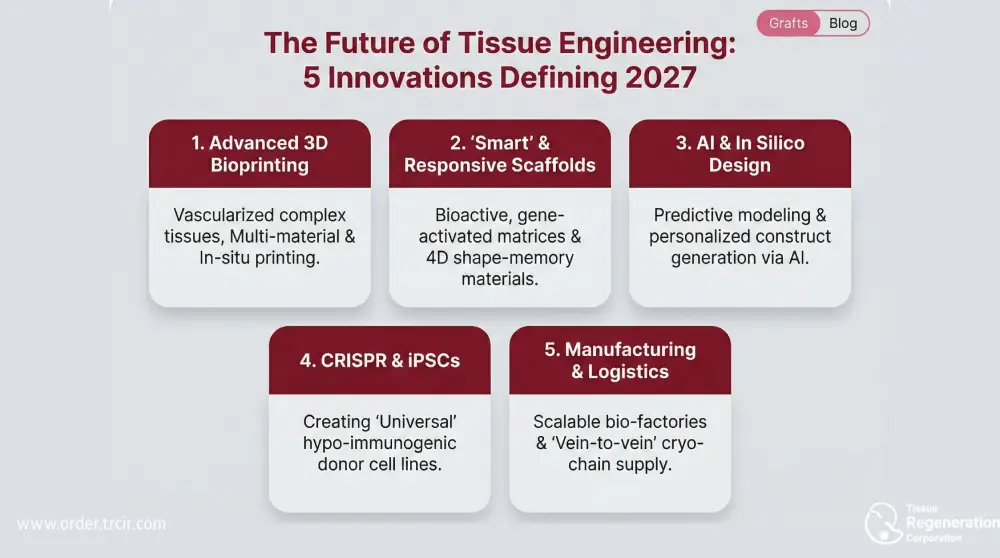
The future of tissue engineering is brighter and closer than ever. By 2027, the field will be defined by the synergy of five key trends: 3D bioprinting creating vascularized, functional tissues; smart scaffolds actively orchestrating the healing process; AI designing personalized constructs in silico; CRISPR-edited iPSCs providing a universal and enhanced cell source; and new manufacturing paradigms enabling this at a commercial scale.
For us at TRC, this is not a distant future. It is the landscape we are helping to build. These innovations are the tools that will allow us to fully realize the mission of regenerative medicine: to empower the human body to heal itself, creating a future where no patient is limited by tissue damage or organ failure.
Sources and Further Reading
- AI in Regenerative Medicine (Nature): Discusses the use of machine learning for optimizing biomaterial design and predicting cellular responses.
- [https://www.nature.com/articles/s41579-023-00965-y] (A 2023 review on AI in regenerative medicine)
- 3D Bioprinting Vascularization (Matter): A 2024 paper detailing a “sacrificial” 3D bioprinting technique for creating complex, perfusable vascular networks.
- Smart Scaffolds and dECM (Frontiers): Reviews the use of decellularized extracellular matrix (dECM) as an advanced, bioactive scaffold for tissue engineering.
- CRISPR in Regenerative Medicine (Cell): A review on the application of CRISPR-Cas9 for creating next-generation cell therapies, including hypo-immunogenic iPSCs.
- [https://www.google.com/search?q=https://www.cell.com/trends/molecular-medicine/fulltext/S1471-4914(23)00192-5]
- Regulatory Pathways for Advanced Therapies (FDA): Outlines the Regenerative Medicine Advanced Therapy (RMAT) designation for cell and gene therapies.
- [https://www.fda.gov/vaccines-blood-biologics/cellular-gene-therapy-products/regenerative-medicine-advanced-therapy-designation]
This video explores how gene editing technologies like CRISPR are intersecting with stem cell research, a key topic discussed in the article for creating next-generation personalized therapies. CRISPR and Stem Cells in Medicine