
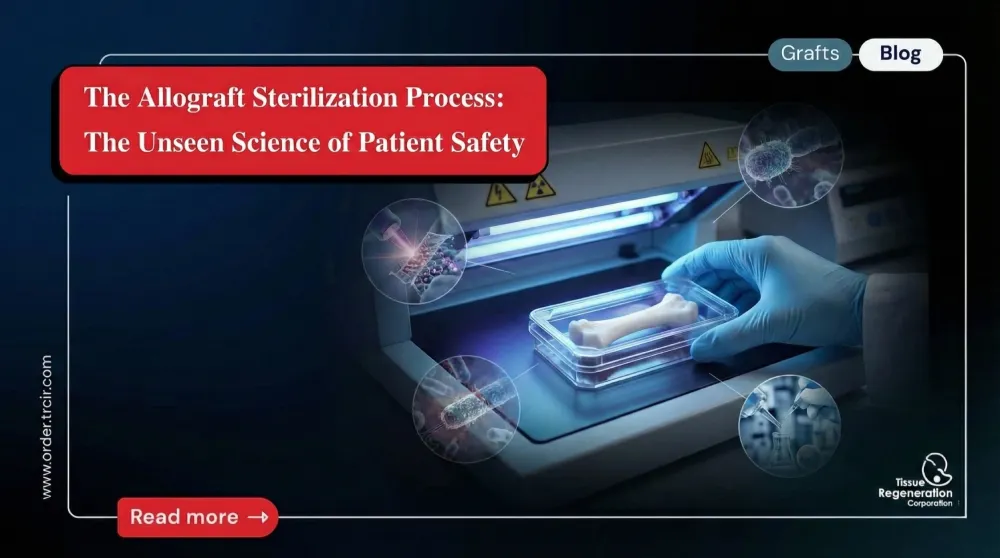
In the world of regenerative dentistry, Human Tissue Allografts are biologic tools of profound potential. They allow us to rebuild, regenerate, and restore what was lost, providing a foundation for implant success and periodontal health. But these materials, sourced from one human being for the benefit of another, carry an immense ethical and clinical responsibility.
A clinician’s trust in an allograft is not just in its clinical efficacy but in its absolute safety. That trust is placed, often blindly, in the complex, unseen, and highly scientific journey the tissue takes from donor to the sterile-packed box. This journey is the allograft sterilization process.
This is not a single step. It is a comprehensive system of safety, a “chain of quality” designed to do two things simultaneously:
- Achieve a Sterility Assurance Level (SAL) of 10^-6, meaning a one-in-a-million chance of a non-sterile product.
- Preserve the vital biological and mechanical properties of the graft.
This is the “Sterile Dilemma”: how to wage all-out war on pathogens without destroying the delicate collagen scaffold and growth factors that make the graft work. For specialists at trcir.com, understanding the allograft sterilization process is not just an academic exercise; it’s the key to truly understanding the product you are placing and the foundation of patient safety.
More Than One Step: A System of Safety
The allograft sterilization process does not begin at a sterilization facility. It begins months, or even years, before the tissue is procured. A truly safe allograft is the result of a multi-layered defense system.
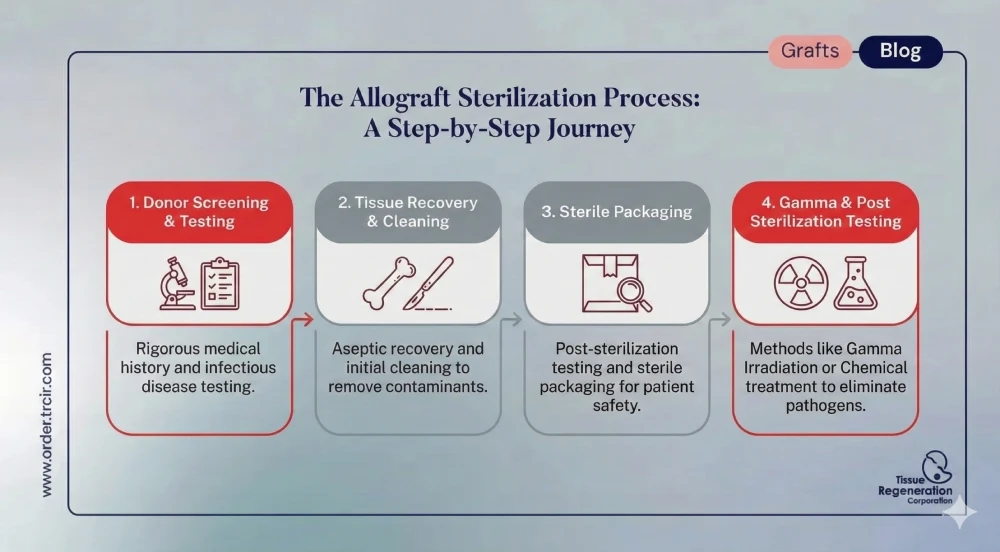
Layer 1: Rigorous Donor Sourcing and Screening
The first step is to never introduce risk in the first place. This is the most critical, non-negotiable part of patient safety. All reputable tissue banks, especially those providing CE certified human tissue products, adhere to exhaustive donor screening protocols. This includes:
- Extensive Medical/Social History: A deep review of the donor’s medical records and lifestyle to rule out risk factors for infectious diseases.
- Serological Testing: A battery of blood tests taken at the time of donation to screen for a panel of infectious agents, including HIV-1/2, Hepatitis B (HBsAg, anti-HBc), Hepatitis C (anti-HCV), and Syphilis.
- Nucleic Acid Testing (NAT): Advanced molecular tests that can detect the genetic material of viruses (like HIV and HCV) before the body has had time to produce detectable antibodies. This “window period” testing is a critical safety net.
Any donor who fails any part of this screening is immediately disqualified. Only tissue from donors with a perfect record proceeds to the next step.
Layer 2: Aseptic Processing in a Controlled Environment
Once a donor is cleared, the tissue is recovered and processed in an “aseptic” environment. This means the entire process is performed in a certified cleanroom (e.g., ISO Class 5) by gowned technicians using sterile instruments. The goal is to prevent the introduction of any new contaminants.
During this stage, the bone is cleaned, marrow and lipids are removed, and the tissue is cut and milled into the final particulate or block shape. This cleaning and lipid removal is a key “bioburden reduction” step—it physically removes potential contaminants before the final sterilization ever begins.
The Main Event: Terminal Sterilization Methods
After being processed and packaged in its final vial or container, the graft is subjected to “terminal sterilization.” This is the final, definitive step that kills any remaining pathogens and renders the product sterile. The choice of method here is critical, as it directly impacts the final product.
1. Gamma Irradiation
This is the most common and widely documented allograft sterilization process for bone tissue.
- How it Works: The packaged grafts are exposed to a precise, validated dose of gamma radiation, typically from a Cobalt-60 source. This high-energy radiation passes through the sealed packaging and the tissue itself, where it collides with and irretrievably shatters the DNA or RNA of any bacteria, viruses, fungi, or spores.
- The “SAL 10^-6” Standard: The goal of gamma irradiation is to achieve a Sterility Assurance Level (SAL) of 10^-6. This is the gold-standard for all medical devices. It does not mean the graft is “mostly sterile.” It means the process has been validated to prove that there is less than a one-in-a-million chance of a single microorganism surviving. This is the highest level of sterility assurance recognized by international standards.
- The Clinical Trade-Off: The “Sterile Dilemma” is most evident here. While gamma is incredibly effective, the radiation, particularly at higher doses, can have “collateral damage.” It can cleave collagen cross-links and potentially damage the delicate BMPs (bone morphogenetic proteins) that give DFDBA (demineralized freeze-dried bone allograft) its osteoinductive kick. This is why the dose is so important. A low-dose, validated process (often 15-25 kGy) is key to balancing sterility with bioactivity.
2. Electron Beam (E-Beam) Irradiation
E-beam is another form of radiation sterilization that is gaining popularity as a modern alternative to gamma.
- How it Works: Instead of photons from a radioactive source, E-beam uses a high-energy stream of electrons accelerated by an electric field. This electron “shower” also destroys microbial DNA.
- Pros vs. Cons: E-beam is incredibly fast—a sterilization cycle can take minutes instead of the hours required for gamma. This reduced exposure time is believed to be “gentler” on the tissue, causing less damage to the collagen matrix. The main limitation is penetration; E-beams do not penetrate as deeply as gamma rays, so this method is best suited for low-density or symmetrically packaged products.
3. Ethylene Oxide (EtO) Gas
EtO is a chemical sterilization method where a toxic gas is used to alkylate the DNA of microorganisms, preventing their reproduction.
- Why it’s Less Common for Bone: While highly effective, EtO has two major drawbacks for Human Tissue Allografts. First, the process requires humidity and heat, which can be detrimental to the tissue. Second, and most critically, the process can leave behind toxic residues (ethylene oxide, ethylene glycol) that can be difficult to fully remove and may cause an inflammatory response in the patient. For these reasons, it is not a preferred method for bone grafts.
4. Supercritical Carbon Dioxide (scCO2)
This is an advanced and innovative allograft sterilization process that is also a cleaning process.
- How it Works: CO2 is subjected to a specific temperature and pressure where it enters a “supercritical” state—it is neither a liquid nor a gas, but has properties of both. In this state, it can penetrate the bone graft like a gas but dissolve materials (like lipids) like a liquid.
- Pros: This method is extremely effective at removing lipids (fats) from the bone, which can otherwise impede revascularization. It is also an effective sterilant when combined with a small amount of a peracetic acid. Most importantly, it is exceptionally gentle and does not damage the collagen structure or BMPs. This process results in a very clean, highly biocompatible, and biologically active graft.
The “V” Word: Validation is Everything
Choosing a sterilization method is only half the battle. Proving that it worked is the other, more difficult half. This is where the allograft sterilization process meets regulatory science.
A tissue bank cannot simply “zap” a graft and call it sterile. They must, under international standards like ISO 11137 (for radiation sterilization), perform a complex validation study.
- They must first determine the “bioburden” (the number and type of microbes) on the tissue before sterilization.
- They must then perform a “dose-setting” study to determine the exact radiation dose required to kill the most resistant organisms found.
- They must then run quarterly “dose audits” to prove that the process remains effective and in a state of control.
This is what you are paying for in a premium allograft. You are paying for the validation, the quality system, the audits, and the proof.
This is also why CE certified human tissue products are the benchmark. To get a CE mark from a Notified Body, a tissue bank must present all of this validation data. The CE mark is the outside world’s verification that the tissue bank has not only claimed their allograft sterilization process is effective, but has proven it according to the world’s most stringent standards.
The Clinical Bottom Line: Why This Matters to You
The allograft sterilization process directly impacts your patient safety and your clinical outcomes.
- A “Clean” Graft: A graft sterilized with a process that also cleans (like scCO2) may handle differently and integrate more predictably because the lipids, which can cause inflammation, are gone.
- A “Strong” Graft: A graft sterilized with a high, non-validated dose of gamma may be sterile, but the collagen may be compromised, leading to faster-than-expected resorption and a potential loss of volume.
- A “Bioactive” Graft: A graft sterilized with a gentle, validated, low-dose method (like E-beam or scCO2) retains more of its native biology. For a DFDBA, this means retaining more of its osteoinductive potential, which can lead to faster and more robust bone formation.
At trcir.com, our commitment is to patient safety. We partner exclusively with tissue banks who are transparent about their allograft sterilization process and who have invested in the science and validation to prove it. When you use a graft from our portfolio, you are using a product where the “Sterile Dilemma” has been successfully solved by world-class science.
Frequently Asked Questions (FAQ)
What is a Sterility Assurance Level (SAL) of 10^-6?
This is the international standard for “terminal sterilization.” It means that the process has been validated to prove that there is a statistical probability of less than one-in-a-million that a single item in the batch is non-sterile. It is the highest standard of sterility in the medical device industry.
Does gamma radiation make the allograft radioactive?
No, absolutely not. This is a common misconception. The graft is exposed to the energy of the gamma rays, but it is not exposed to the radioactive source itself. It is physically impossible for the graft to become radioactive, just as a person does not become radioactive after receiving a chest X-ray.
Which allograft sterilization process is the “best”?
There is no single “best” method, but rather “best-in-class” applications. The “best” allograft sterilization process is one that is validated for the specific tissue being processed. Gamma is the industry workhorse and highly reliable. E-beam and scCO2 are often considered more advanced and “gentler,” potentially preserving more of the graft’s biological activity, but the quality of the validation is what truly matters.
Does the sterilization process damage the osteoinductive properties of DFDBA?
It can. This is the heart of the “Sterile Dilemma.” High-dose radiation (above 30 kGy) has been shown in some studies to reduce the activity of BMPs. This is why leading tissue banks use the lowest possible validated dose (often 15-25 kGy) to achieve SAL 10^-6 while preserving as much of the graft’s biological potential as possible.
Why can’t you just use an autoclave (steam sterilization) for bone?
Autoclaving uses high-pressure steam and extreme heat. This method is incredibly effective for metal instruments, but it would completely destroy a bone allograft. The heat would “cook” the collagen, denaturing the proteins and rendering the graft biologically useless.