
Managing complex injuries requires more than just standard bandages; it demands a deep understanding of the physiological barriers to recovery. For healthcare providers, surgical assistants, and clinical managers, staying updated on non-healing wound treatment options is critical to preventing severe complications such as osteomyelitis or amputation. At TRC (Tissue Regeneration Corporation), we recognize that a “non-healing” or chronic wound—defined as a wound that fails to progress through a timely sequence of repair—requires a multi-disciplinary approach backed by regenerative medicine.
The challenge with chronic wounds, such as diabetic foot ulcers (DFUs), venous leg ulcers (VLUs), and pressure sores, often lies in a stalled inflammatory phase. This delay is usually caused by underlying systemic issues, local infections, or a lack of viable extracellular matrix (ECM). By utilizing advanced biological solutions, clinicians can jumpstart the healing process and provide the structural support necessary for tissue closure.
Understanding the Etiology of Chronic Wounds
Before selecting from the various non-healing wound treatment options, a thorough assessment of the patient’s vascular status and nutritional health is paramount. Most chronic wounds are characterized by high levels of proteases, which break down the body’s natural growth factors and scaffolding. This creates a hostile environment where traditional dressings often fail.
The goal of modern wound care is to transform a chronic, “stagnant” environment into an acute, “healing” one. This is achieved through the “TIME” acronym: Tissue debridement, Infection control, Moisture balance, and Edge of the wound (epithelial advancement). However, when standard care fails for more than four weeks, advanced biological interventions become necessary.
The Role of Advanced Allografts in Wound Care
One of the most effective non-healing wound treatment options involves the use of placental tissues and skin substitutes. At TRC, we provide specialized allografts that act as a biological bridge for difficult-to-treat wounds. These tissues are naturally rich in regenerative properties that traditional synthetics cannot replicate.
Dehydrated Human Amnion/Chorion Membrane (dHACM)
Amniotic tissues have gained massive popularity among wound care specialists and podiatrists. These allografts contain essential growth factors, cytokines, and a natural collagen matrix that facilitates cell migration. Because they are immune-privileged, the risk of rejection is minimal. Using TRC amniotic solutions can significantly reduce healing time for patients who have struggled with stagnant ulcers for months.
Human Skin Allografts
For deep or extensive wounds, human skin allografts serve as an excellent temporary cover or a permanent scaffold for dermal regeneration. These allografts help in controlling fluid loss, preventing infection, and providing a template for the patient’s own cells to populate. In the context of non-healing wound treatment options, skin allografts are often the “game-changer” for patients with exposed tendons or bone.
Negative Pressure Wound Therapy (NPWT)
Negative Pressure Wound Therapy remains a cornerstone in the management of complex wounds. By applying sub-atmospheric pressure, NPWT removes excess exudate, reduces local edema, and increases blood flow to the wound bed. When used in conjunction with biological grafts from TRC, NPWT can accelerate the formation of granulation tissue, making it a powerful combination in the arsenal of non-healing wound treatment options.
Hyperbaric Oxygen Therapy (HBOT)
For wounds where ischemia is the primary culprit, Hyperbaric Oxygen Therapy offers a systemic boost. By breathing 100% oxygen in a pressurized chamber, the amount of oxygen dissolved in the patient’s plasma increases. This hyper-oxygenation stimulates angiogenesis (the growth of new blood vessels) and enhances the ability of white blood cells to kill bacteria. While expensive, it is a proven choice among non-healing wound treatment options for refractory diabetic ulcers.
Bio-Engineered Skin Substitutes and Scaffolds
The field of bio-engineering has introduced various cellular and acellular matrices. These scaffolds are designed to mimic the human dermis. Some are derived from bovine or porcine collagen, while others are purely synthetic. However, clinical preference often leans toward human-derived allografts because they contain the specific proteins and signaling molecules that the human body recognizes most efficiently.
At TRC, our focus is on providing human-derived non-healing wound treatment options that align with the body’s natural healing pathways. These bio-active materials do more than just cover the wound; they interact with the wound microenvironment to switch off the chronic inflammatory response.
Debridement: The Essential First Step
No advanced therapy can succeed without proper debridement. Removing necrotic (dead) tissue, biofilm, and bacteria is essential. Sharp debridement remains the clinical standard, but enzymatic and autolytic debridement also play roles in specific patient populations. Once the wound bed is “prepped” and clean, the application of a TRC allograft can take place with a much higher probability of success.
Selecting the Right Treatment Pathway
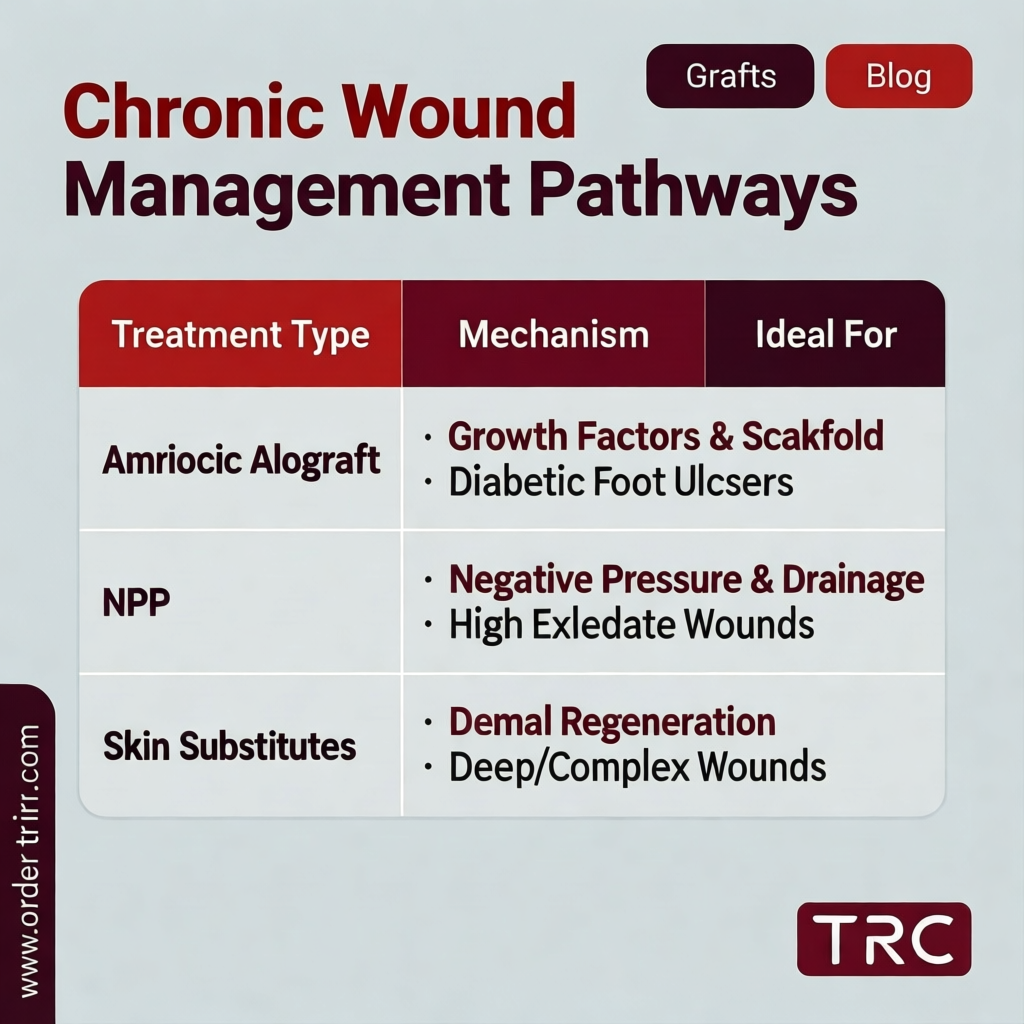
Choosing between non-healing wound treatment options requires a strategic look at the patient’s lifestyle and the wound’s characteristics:
- For high-exudate wounds: NPWT combined with absorbent allografts.
- For neuropathic ulcers: Total contact casting (offloading) plus amniotic membrane grafts.
- For ischemic wounds: Revascularization surgery followed by biological tissue application.
Clinicians who partner with TRC gain access to a portfolio of tissues specifically processed to retain their biological activity, ensuring that even the most stubborn wounds have a chance at closure.
The Economic Impact of Advanced Wound Care
While advanced non-healing wound treatment options like allografts may have a higher upfront cost than standard gauze, they are more cost-effective in the long run. Faster healing means fewer clinic visits, reduced risk of hospitalization, and the prevention of expensive surgical amputations. For hospital administrators and clinic owners, investing in high-quality biological materials from TRC is a sound financial and clinical decision.
FAQ: Non-healing wound treatment options
What is officially considered a “non-healing” wound?
A wound is generally classified as non-healing or chronic if it has not shown a 40% to 50% reduction in size after four weeks of standard care. At this point, clinicians should investigate advanced non-healing wound treatment options.
How do TRC allografts help in closing a diabetic ulcer?
TRC allografts, particularly amniotic tissues, provide a concentrated source of growth factors and a structural scaffold. They help “restart” the healing cycle by providing the signals that the patient’s own cells need to migrate across the wound and close the skin gap.
Is Negative Pressure Wound Therapy painful?
Most patients tolerate NPWT well, though the dressing changes can be uncomfortable. It is often used as a preparatory step before applying biological grafts to ensure a healthy, granulated wound bed.
Can allografts be used if the wound is infected?
Active infection must be treated with systemic antibiotics and proper debridement before applying most biological allografts. Once the bacterial load is controlled, non-healing wound treatment options like placental membranes can be used to promote final closure.
Are these treatments covered by insurance?
Many advanced non-healing wound treatment options, including certain allografts and NPWT, are covered by major insurance providers and Medicare, provided that documentation shows the wound has failed standard therapy for at least 30 days.
Why choose human tissue over synthetic alternatives?
Human tissue allografts contain a complex array of natural proteins and matrix components that synthetics cannot perfectly mimic. Tissues from TRC are processed to be biocompatible, reducing the inflammatory response and promoting more natural tissue integration.
References:
- Frykberg, R. G., & Banks, J. (2025). Challenges in the Treatment of Chronic Wounds. New England Journal of Medicine – Wound Care Supplement.
- Gould, L. J., et al. (2024). Wound Healing Society 2024 Update on Guidelines for Diabetic Foot Ulcers. Wound Repair and Regeneration.
- Tissue Regeneration Corporation (TRC) Research Division (2026). Comparative Analysis of Amniotic Allografts in Chronic Wound Closure.
- Armstrong, D. G., & Meyr, A. J. (2023). Basic Principles of Wound Management. UpToDate Orthopedics and Podiatry.
- Lavery, L. A., et al. (2024). Negative Pressure Wound Therapy with Instillation: A Review of Evidence-Based Medicine. International Wound Journal.